Total Pageviews

Showing posts with label Milton Acorn. Show all posts

Friday, 5 December 2025

Milt taught me to listen to birds (Faiers poem)

Another poem in fond memory of Canada's People's Poet


Milt taught me to listen to birds

(for a green eyed Tara Goddess)


That summer day, fated and fateful
Milt visiting, joking we were Rhodes scholars
at my Rhodes Ave house.
In the afternoon bake
I took Milt to my favourite big city haunt
Ashbridges Bay
and on a small crest Milt 
showed me the shaman way 


listen to the Ravens, Chris
 

ignoring (temporarily) blonde bikinis
spread below on wet sand blankets
Milt pushed our gazes further:
sea captains of paradises
horizon scan of Lake Ontario, an inland sea to
Island Milt
 

Testosterone makes us show-offs for our Goddesses.
Poets, I told Christy once
poets, we are mad men - running naked
across rainswept fields
hoping for the lightning strike - 
the best are hit more than once
crazed and crazier with each visitation
of white heat/white light/White Goddess inspiration

but I have digressed from Milt's lesson
the blondes to blame, no doubt
(or dreams of a Green-eyed Tara Goddess incarnate)
Can't say I heard the birds clearly
that gorgeous summer day
but I knew then to be a true poet
I had to follow the shaman way
Milt had softly shown me 

listen to the birds, Chris

 
Thank you Milt, your advice
sings true to me this summer morning
doves cooing and crows cawing
dawn chorus keeping me awake,
encouraging this poem
for you, and the gifts of a Green-eyed Goddess


summer 2012


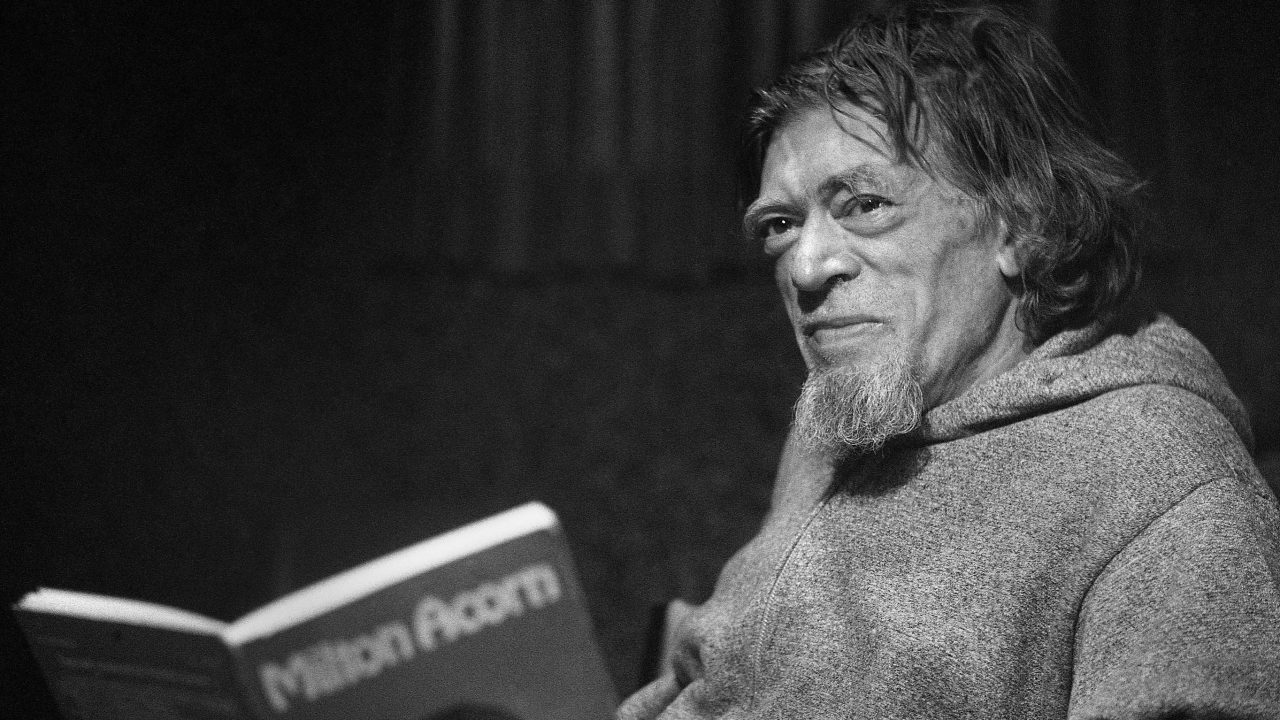
Milton Acorn: The People's Poet (Photo Album)


comments from 2012 when posting comments on my blog actually worked:

Milt is Milton Acorn, Canada's People's Poet, and the poet
many believe to be our most important national poet.
Milt received our highest literary honour, the Governor General's Award
for poetry, and an honourary doctorate from his home university on 
Prince Edward Island. Milt was a comrade, a friend, and a mentor.


~ ~ ~ ~ ~ ~ ~ ~ ~ ~ ~ ~ ~ ~ ~ ~ ~ ~ ~ ~ ~ ~ ~ ~ ~ ~ ~ ~ ~


Conrad DiDiodato has left a new comment on your post "Milt taught me to listen to birds": 

"Listen to the birds"--
never wanted to run so badly 


Posted by Conrad DiDiodato to Riffs & Ripples from ZenRiver Gardens at 24 July 2012 09:55 


~ ~ ~ ~ ~ ~ ~ ~ ~ ~ ~ ~ ~ ~ ~ ~ ~ ~ ~ ~ ~ ~ ~ ~ ~ ~ ~ ~ ~

Conrad DiDiodato has left a new comment on your post "Milt taught me to listen to birds": 

"Listen to the birds"--
wild grass under a cloudless sky 


Wednesday, 3 December 2025

memories of Milton Acorn and Canadian Liberation Movement: Jim Larwill

 part of an email from an old comrade:


Good to see that Kent Bowman poem on Milton.  Yes that sounds like Milt.  There was a time Milt told me he built a house and forgot to put any doors or windows into it.  Hard to believe unless you knew Acorn.  On the other hand when the CLM was tearing itself apart, I as the Ottawa Chairman didn’t know what the hell was going on in Toronto, so I went to TO and looked up Milton at the Waverley Hotel because I knew Milt was the only one I could trust to give me the straight goods on what was happening with the central office and the Toronto clubs.  I will always remember that afternoon hanging out with Acorn at the Crest Grill.  I think I have a vague memory of Milton telling me I was a poet, and this was before I was really starting to write.  I think at the time I took it as an insult.  Who in there right mind would run away into the woods and waste their life writing poetry?

On the political side of things it is funny… or not… how our predictions from back then have come true.  Get too tied to the US economically and it would mean a loss of independence for Canada.  In a strange way Trump is just stating the obvious outcome of being totally integrated economically.


Anyway I continue to work on my YouTube channel.  I have to say I miss live performance and I find the virtual media some what alienating, but I do like the creativity of video editing when the learning curve isn’t driving my old brain a bit crazy sometimes.  Here is a link to the latest one.  I have mostly been working on my “i Wolf” literary theory of human cultural evolution, but this one is a poem.

Keep marching comrade…

jim… aka Raven King


Jim's very cool and challenging video - watch it!

https://www.youtube.com/watch?v=EX6LVIV-vmE&t=11s

Friday, 28 November 2025

Milton in Motion (1973): Kent Bowman poem

 Milton Acorn and I were comrades in the Canadian Liberation Movement (CLM) half a century ago. Milton was a dyed in the wool Canuck nationalist, vehemently opposed to the U.S. cultural control of Canada. Fifty years later, our concerns over an Amerikan takeover have proven true with Trump's threats to annex us as the 51st state. 


Hans Jewinski, better known as Toronto's "Poet Cop", was riding

in his squad car when he noticed fellow poet and demonstrator 

Milton Acorn and his merry band walking in a westerly

direction. Hans stopped his car and asked Milton where he was

going. Milton answered, "We are on our way to a demonstration

at Allan Gardens." Hans offered to escort Milton and his group

to the demonstration. As Hans turned on the flashing squad car

lights, Hans' partner edged further down in his seat, hoping not

to be seen by any other passing fellow police officers. 


Several weeks later, Hans encountered Milton and his followers

again. This time, they were walking east towards the Don River.

"Milton, where are you going?" asked Hans. Milton replied, "We

are heading to Allan Gardens for a demonstration." With a look

of amazement, Hans declared, "Milton, you're heading in the

wrong direction!!"


*dedicated to Milton Acorn, based on an incident described by Hans Jewinski

from Looking into the Fish Tank, poems by Kent Bowman

Aeolus House, 2022


From: Milton Acorn: In Love and Anger – Richard Lemm, Writer

Milton Acorn, The People's Poet


from wikipedia: 

Acorn was awarded the Canadian Poets Award in 1970 and the Governor General's Award in 1976 for his collection of poems, The Island Means Minago.[15][16] In 1977, Acorn introduced the Jackpine sonnet, a form designed to be as irregular and spikey (and Canadian) as a jack pine tree, but with internal structure and integrity. Without a fixed number of lines and with varied line lengths, the Jackpine sonnet depends on interweaving internal rhymes, assonance and occasional end-rhymes.[17]


Great memory  & poem

Judy Haiven, PhD 
Writer/activist
Halifax NS
Canada
Tel 902 718 7445

Very nice!
Pat Connors

Thanks, Chris for this lovely memory of Milton.
btw, I tried to post a comment but a message popped up indicating to try again later. Reminded me of a pop bottle cap contest
Hope you're well.

Personally, I've found 2025 a terrible year; I'm looking forward to 1977. [sic]
cheers Henry Martinuk

Wednesday, 3 July 2024

poet Jim Larwill: youtube vids on Milton Acorn and poetry from the margins

I heard from old comrade Jim Larwill today (Canadian Liberation Movement - google it). Jim was a mainstay of the Purdy Country Poetry Fests I held for eight summers at my ZenRiver Gardens retreat. Great to hear from him and to know that he's staying very alive and active on the Canuck poetry scene with his online vids. Please check him out!   

Hey Chris,


How are things going these days?  Same old same old here.  Slowing down with age a bit.  Writing less but trying to do something with some of it.  I don't know if you remember the paper I gave on Acorn at Purdyfest but I have turned it into a video/


The beauty of the internet is that today a poet can be ignored by the entire world!!  I miss reading to a live audience sometimes.   Covid seems to have shut down most reading series and I am too tired in the evenings to drive into town and all the way back anyway.  Videos are a hell of a lot more work that reading to a live audience...  and a live audience doesn't have an algorithm between the stage and the seats.

Anyway I hope you are well.

Jim

-- 
Jim Larwill is an Omnigothic Neofuturist. 

You can read his poetry and essays at: http://web.ncf.ca/wolf

You can read "i Wolf" the Carnivoreque literary theory of "human" origin at: http://web.ncf.ca/eu386/iWolf

You can watch his You-tube videos at: https://www.youtube.com/channel/UCXNKeq1xZcCY4QJ2_vI6oxg


some of Jim Larwill's memories of poet and CLM comrade Rob Macleod from our email
exchanges today:

The other day I happened to come across an obituary for Rob Macleod who it seems passed a few years ago.  Rob like all of us had his quirks, but he actually was such a really good guy.  Rob over the years was good at keeping in touch with me (phone to pass on bad jokes and puns on a regular basis) and I kind of eventually noticed I hadn't heard from him in a while.  When he became a father I did hear less because he was busy.  He absolutely adored his daughter.  I was quite sad to hear of his death.

So many memories come to mind.  There is is picture of me standing in the middle of the centennial flame of Parliament Hill where I am lighting a Time magazine to start a bonfire of American magazines which were being dumped into Canada.  A successful demonstration that helped bring in protection for Canadian Mags.  1974?  In the background of the picture Rob is holding the CLM banner with a Mountie standing beside him.  Of all of us I would say Rob was probably the closest to Acorn.  He took a trip to PEI with Acorn where Acorn lost his People's Poetry medal on a beach lamenting that eventually some American with a metal detector would find it some day.  Rob said he was working on a book on Acorn.  Not sure what happened with that.  It is maybe important we try to keep out version of history alive for a little while.  Maybe I should do a vid of my Acorn memories?

Scanned Document-2.jpg

Jim and Rob on Parliament Hill
photo Jon Penner

Saturday, 13 January 2024

Milton Acorn Is Full of Poetry

 I've been reading Olivia Chow's amazing 2014 autobiography My Journey. So I woke up dreaming of my years in Toronto, and Milton Acorn. A review of Olivia's book will follow when I've finished reading it, but in the meantime, here's an old poem of mine about Milton.


Milton Acorn is Full of Poetry


even tho
you repeat yourself
thinking even your mumbles
are more important than
the truths of beginning poets

and even tho you've never even
acknowledged that I write poetry
you old fart

I am still a student of
THE MILTON ACORN SCHOOL OF POETRY
even if you are too
goddamned proud to open it

So the only way I could join
was to declare it
OFFICIALLY OPEN
in this poem
So here it is, Uncle Miltie

And even tho I've said
a nasty thing or two
in this dedication
More Poems for People is still
the only book I read often enough
to hide my money in

from my book Foot Through the Ceiling
1986, Aya Press
it won the inaugural Milton Acorn People's Poetry Award in 1987

note 1: Milton did eventually recognize that I had some talent as a poet

note 2: The story of finding hidden money in More Poems for People is true. I can't remember which birthday, prob. circa the late 1980s, but I shook out a twenty dollar bill and went to Greenwood Racetrack.  

See original image


Wednesday, 5 April 2023

Picnic with Al (Purdy)

 April is Poetry Month, and April 21st is Canada's national Al Purdy Day

Picnic with Al

Al, you tough brilliant old bastard
you've been dead for what,
6 ... 7 years now?
And yet your spirit still soars thru
this godforsaken country north of Belleville
permeating the equally godforsaken Canadian poetry scene

We, your people's poetry progeny
miss you and Uncle Milt so much
we've organized a festival with your name all that's necessary
to announce our intentions

Now the formal parts of the festival are over
It's time for beer and finger food and
real poetry in the graveyard where your
spirit keeps company with failed Loyalist ancestors

Today you've got us to lift your spirits
one crazy old hippie poet (me)
is ringing a Buddhist temple bell
reminding you not to be late for the feast
of poets reading your poetry
all beer sodden, chicken smeared
and better for it

This early August day in A-burgh's settler cemetery is perfect
sunny, the wind coming up as the bell chimes
its invocation: animals may appear I intone
& sure enough, a second turtle pops onto the log
from the millpond's cool depths

I remember the wake in Belleville
in the posh private school dining hall
more Hogwartz than the owners realized
Halfway through the turgid readings
you flew from the rafters
in the form of a bat
swooping among your guests
and all recognized your spirit
with authentic laughs

Melanie reads your poem "The Buddhist Bell"
after the goofy invocation
and as our vision clears
we see the turtles smile
as Jeff Seffinga appropriately reads "At The Quinte Hotel"
all of us joining to chorus "for I am a sensitive man!"

James Deahl lounges on your tombstone
carved in the shape of an open poetry book
his arm is draped as if over your shoulder
while he props on this convenient lectern
reading your words of drunken wisdom

Suddenly rude crows caw above the pond
Uncle Milty with his raven clan
clangour their guttural approval
People's Poetry is alive and well
laughing from beyond the grave
mingling pitch perfect with Jim's voice


Chris Faiers
Oct. 6/07
 

From 2007 until 2014 I organized 8 annual Purdy Country Literary Festivals at my ZenRiver Gardens retreat near Marmora, Ontario. The above poem was inspired by the first "Purdy Fest" gathering.

Dedicated to James (Jim) Deahl about the Aug. 6/07
picnic celebration in Ameliasburgh by Al Purdy's grave.

* Uncle Milty is of course Milton Acorn, Purdy's best friend
and fellow Governor General award winning poet.

this poem appeared in Umbrella, Quinte Arts Council's magazine, May 2008

published in And Left a Place to Stand On: Poems and Essays on Al Purdy, Hidden Brook Press, 2009


Friday, 29 November 2019

bill bissett's brain

Hi Henry  :  )

Thanks for letting me know the blewointment antho arrived OK. I was beginning to suspect Canada Post had screwed up once again. And thanks for the compliments on my "5 mins ago . . ." poem in the antho. I wrote that poem in 1984, and it's by far my most anthologized work. In it I'm pretty sure I coined the term EQ as a corollary to IQ. I did a blog posting a while ago to establish a claim to this - for what it's worth:

http://riffsandripplesfromzenrivergardens.blogspot.com/2015/03/i-invented-eq-in-1984.html

Last night I finally reached Terry by phone, and we enjoyed our usual 1 1/2 hour chat catching up on TO poetry scene news. Terry was very interested to learn about the upcoming 80th birfday celebration of bill at the Tarragon Theater on Dec. 9. He said he'll check with Anna to get the online details, and he sounded like he was planning on attending. Terry met bill a couple of years ago when bill was in the process of moving. bill was unloading various items of flotsam and jetsam and he gave Terry a couple of paintings, altho Terry doesn't know who painted them (he didn't think they were by bill) or even if they were a gift or for Terry to keep for safekeeping. bill also gave Terry a rubber brain, hence Terry's claim that he has bill bissett's brain!!! All the more reason for Terry to attend bill's event at Tarragon.

Terry was aware of all the recent feting and publicity for Margaret Atwood's 80th birfday, and he liked my comparison of the parallel celebrations as the "Upstairs, Downstairs" of Canadian poetry:  )-

Talking about bill reminded Terry that many decades ago bill and Milton Acorn collaborated on a yet unpublished book. Some mysterious dude named Schmaltz was supposedly going to finally publish it, but nothing has happened re this so far as Terry is aware. 

Think I'll pass on the Chernobyl doc for the time being - as you know, I'm already far behind on all the various docs you've sent me  :  )

peace & poetry power!
Chris

p.s. I'll cc Anna on this so she'll know what Terry is talking about re bill bissett's Tarragon event


On 2019-11-26, at 1:53 PM, Henry wrote:

Hi Chris!
I checked for mail on Monday but there was nothing. Fortunately, I decided to check again when I took in the night air ;-)

Much to my excitement, your package arrived!!! Thank you so much for the blewointment Anthology! What a great work to receive!
I had to read Milton's poem immediately and then your poem. Your poem really shook me in its relevance. We have gotten complacent with the nuclear threat that continues to be a danger.

Coincidentally, I borrowed the recent tv miniseries 'Chernobyl' DVD from the library. It's about the 1986 nuclear catastrophe in the Soviet Union. Absolutely harrowing! Particularly illuminating is the examination of why the disaster occurred. It makes worried about the maintenance and operations of nuclear power plants. Darlington is uncomfortably close and I heard of a disaster test for the surrounding region recently.

Are you interested in seeing 'Chernobyl'? Warning: may scare the shit out of you! ;-)

thanks again for blewointment and your kind inscription!

Thursday, 12 October 2017

The Red and Green Pony: A Canadian Masterpiece (review of Milton Acorn by Ron Dart)


                          THE RED AND GREEN PONY :

                               A Canadian Masterpiece


                                        by Ron Dart


I’ve Tasted My Blood was published in 1969, and many thought the poetic missive would take home the GG Award in 1970. George Bowering and Gwendolyn MacEwen won the Awards, and there was an immediate reaction to this disappointment. Robin Mathews played a significant role in blowing the whistle on the decision, and many others joined the opposition, and Acorn was offered the first Peoples Poet Award in 1970 as a stinging rebuke to being bypassed for the GG Award.


Al Purdy was instrumental in the bringing together I’ve Tasted My Blood,

and he wrote a lengthy and informative ‘Introduction’ to Acorn’s collection of poems. Most of I’ve Tasted My Blood is poetry, and poetry at the highest and most challenging and suggestive level, but there are two short stories at the centre of the book: ’The Legend of the Winged Dingus’ and ‘The Red and Green Pony’ are Acorn at his parabolic and storytelling best. Purdy had this to say about both tales:


       the stories are not ones that could be written by any other poet in

       Canada. They are a complete surprise, especially coming from a

       word-buster like Acorn.
(p. XIV)


Or again:


       I’d call both stories simple magic, for each is a long-term spell cast

       on the reader. I’m a pretty factual person myself, and yet no matter

       how many times I read these stories or type them-they get to me. And

       I start to wonder: could there be a world like that? Well, if there can’t

       be, the next best thing is Acorn’s stories. My belief amounts to a naïve

       certainty that both are masterpieces.
   (p. XIV)          


There you have it. Purdy thought that both ‘The Legend of the Winged Dingus’ and ‘The Red and Green Pony’ were literary masterpieces and only Acorn could have composed such evocative stories. This short essay will reflect on the content of ‘The Red and Green Pony’ and ponder the political meaning of it.

Image result for milton acorn


 T he Red and Green Pony is one of the most important Canadian political parables, and it was written in the 1950s by Milton Acorn. The tale is a well told political fable that records and anticipates much that was about to unfold in the latter half of the 20th century. The leading protagonist is Tommy, and there is good reason to suspect that Tommy could be identified with Tommy Douglas (voted the most important Canadian’ in the 20th century in a CBC survey in 2004 and still on secret and classified files of the RCMP and CSIS). Acorn was holding Douglas high in a time when most reviled, opposed and sought to topple Douglas through a variety of questionable means. Douglas, for those who do not know, was the father-in-law of Donald Sutherland and the grandfather of Kiefer Sutherland.


The Red and Green Pony has a dynamic momentum to it, and it is divided into five sections that intricately interlock with one another. Section 1 walks the reader into a dream sequence in which Tommy enters a forest. The trees and leaves have a way of speaking to Tommy in this magical realm about things that went to his deeper longings and soul. It was in this dream world that Tommy met the red and green pony that was both red and green at the same time. It was hard to believe, even in a dream, that a pony could be both red and green. A conversation ensued between Tommy and the pony about the actual reality of the pony. There is no doubt that Tommy is drawn to the feisty pony, but he is young on the journey, and he is not quite sure what to make of the vision and conversation with the pony. The hair of the pony was ‘tangled’ and Tommy noted that it needed ‘combing’. It was just a matter of time before ‘the dream was gone’, ‘he was lying in bed’, ‘it was day and not as bright as the dream’ and Tommy had to remember to bring a ‘comb and a hairbrush’ when he next returned. Section I has a surrealistic and naïve visionary quality about it, but there is much in it about the tangled idealism of the political left that needed combing to formally engage the political process in a meaningful manner. Most knew what ‘Red’ meant on the political spectrum, and ecological ‘Green’ was just emerging. The political pony that Acorn envisioned in this parable would be a fusion of left of centre ‘Red’ and ‘Green’. But, there would be opposition from the old guard. It is in Section 2 that the dialectic of thesis becomes antithesis and a waking from the dream occurs.     


Section 2 shifts from the dream world to a sort of waking state. Tommy is now in his parents’ home, and he is about to join them for breakfast. His father is reading a paper, and his initial comments are, ‘CCF’s running a candidate here again. Are they ever going to learn that we here in Ontario don’t want them?’ Tommy’s mother is a faint echo of his father’s political views. His father then mentions the USA: ‘Yanks kicking up a fuss about Negroes going to white schools again’. Tommy’s mother tries to move the discussion from newspaper politics to Tommy’s need to be clean and eat a proper breakfast. There is no doubt that Tommy comes from a family that is rather bourgeois and right of centre on the political spectrum. It is just a matter of time before Tommy blurted out that he had had a dream, and in the dream he had seen a red and green pony. His father has no problem with the dream provided it remains a dream. ‘Now did you ever see a pony on the street with red and green patches?’ Tommy wants to make it clear that the dream was real, and it has significant meaning. The mother makes clear ‘it was only a dream’. Both father and mother become quite worried that Tommy might confuse a dream with reality and begin to act rather foolish ‘on the street’. The conversation ended, and Tommy went upstairs and looked out the window. He saw a sign that said. ‘Warning, No swimming or fishing. Water polluted. Order of Ontario Department of Health’. Tommy was late for breakfast that day, and he soon forgot about the red and green pony. The day soon passed, ‘but when Tommy went to sleep that night he put a comb under his pillow’.


It does not take too much reflection to see that Tommy is Tommy Douglas of the CCF, Tommy’s vision often collided with an established view of reality, the red and green embody leftist thought and ecological issues, and the wild and tangled hair on the solid body (that needed combing) reflected all the diverse and often prickly elements in the political left that Douglas had to comb. The fact that this short story was written in the 1950s makes it abundantly clear that Acorn anticipated many of the substantive issues that were about to emerge on the public stage in the 1960s-1970s and that we still face today. The dialectical antithesis was about to become a more demanding synthesis, though.


Section 3 walks the reader back into the magic realism drama of Tommy. The leaves greet Tommy with great joy as he enters the world where the ‘flowered branches’ and the ‘tufts of the grass’ swung over him like ‘pony-tails’. The red and green pony is there to meet Tommy, and he inquires about the comb—it had been brought and Tommy brushes all the tangles and knots on the pony’s hair. It is just a matter of time before another conversation begins between Tommy and the pony about Tommy’s father and his right of centre political ideas. The question is raised about whose facts and view of reality should be listened to and why. Who defines what is dream and what reality?  Tommy bonds closer and closer to the red and green pony, and he is soon on the pony’s back and riding the friendly yet energetic animal with much delight and fondness. Section 3 ends with the dream over, and Tommy waking to the sound and sight of a starling on his window-sill. Tommy looks down at the ‘polluted river’ and a world in which ‘ugliness was coiled with beauty’. The vision has definitely deepened and solidified for Tommy in Section III, and the experience of the dream world is set in stark and graphic contrast to the lived reality his mother, father and the economic and ecological setting of the time.


Section 4 takes Tommy and the interested reader back into the world of Tommy’s parents. The red and green pony is now much more real to Tommy, and his interpretation of what he sees and does is informed by such a reality. Tommy’s mother tends to come across in the story as warmer and more affectionate, whereas his father is stern, dogmatic and ideological. Tommy’s mother finds him down by the polluted river and urges him to return home for dinner. A family feud soon emerges between mother and father about what to do with Tommy’s increasing interest and belief in the reality of a red and green pony. The intensity of the clash becomes so pronounced that Tommy runs away after declaring that he has seen and believes in the Red and Green Pony with capital letters. The commitment to the vision is now dividing the family and parents.


Section 5 brings the tensions between idealism and realism together in a thoughtful manner. It is Nature again that has become Tommy’s real family, and it is in the arms of Nature that Tommy is comforted and befriended. It is

Tommy’s mother that comes searching for him, and there is a poignant episode in which Tommy watches a ‘long legged wolf spider’ attack and kill a harmless bug on a tender grass-stem. The Red and Green Pony appears again and wonders if Tommy has brought the hairbrush. Tommy had brought the hairbrush, and he began combing out the deeper knots on the pony, and at the same time he can vaguely hear his parents. There is a distinctive sense in which Tommy is living in two worlds and he needs to know which he will heed and why. There is a surrealistic scene in which the Red and Green Pony runs straight through Tommy’s parents (they seem to have no substance), and he then leaves Tommy with a few comments to ponder as the tale draws to a close. ‘To listen properly you’ve got to do it and not talk about it’. Much of this story is about who will be listened to and why. Tommy is pulled in diverse directions through the mini-drama, and there are consequences for not hearing and heeding the best voices. The final lines conclude and sum up the deeper message of the fable.

“Where are we going, Red and Green Pony?” he asked.

“All the way,” said the pony. “Often and often you’ve got to go all the way so you can properly get back”. There is something in the final few words that have echoes of Plato’s famous cave parable, and I’m sure Acorn was quite aware of his updated version of Plato’s synthesis of philosophy and politics in a mythic form.


The Red and Green Pony hovers on the edge of an allegory—it is part myth, part fable, part parable. The message cannot be missed. The tale is about the process that must be gone through to see through different and more informed eyes. The transition means letting go of much only to receive much. The pilgrimage often means going all the way before the journey back can be taken. We might wonder what going all the way means, but this is the mystery and uncertainty that Acorn leaves us with as the short story ends.


It is significant to note that Milton Acorn’s religious roots were Anglican, and Tommy Douglas’ were Baptist. Both had leanings, even in the 1950s, in the direction of both red and green, and, in this sense, the common good of both the land and people were united in one integrated whole. The Red and Green Pony is must read and classic of Canadian political tale telling. It is rather sad that so few know such an evocative political parable. There is a significant sense in which Acorn’s The Red and Green Pony and Douglas’

classic parable, Cats and Mice, have much in common, and the obvious convergence of these not to be forgotten tales make two points abundantly clear: art, religion and politics should not be isolated from one another, and equally important, faith and politics need not unite and merge into a republican brand of conservatism. The more we are immersed in the life, activism and writings of Tommy Douglas and Milton Acorn, the more we will be walked into a unique Canadian synthesis of faith, literature and politics that has still much to commend it. 


Appendix


It is significant to note that when Acorn was in the Vancouver area between 1963-1968, he had an ongoing confrontation in 1965 with the Stanley Park Aquarium. A killer whale was being kept in confined space and Acorn relentlessly (mostly alone) challenged the administration to change the conditions of the whale’s imprisonment. The whale did try to break loose through a port hole, and in the process, was seriously damaged. There is a fine poem by Joe Rosenblatt called “Milton & the Swan” that touches on the incident and a trip to the zoo taken by Acorn and Rosenblatt. We can see, in the killer whale—Stanley Park Aquarium incident in 1965, Acorn was ahead of his time in Animal Rights also.          


Ron Dart                              


                                                                    ~   ~   ~   ~


On 2017-10-15, at 2:36 PM, Robert Acorn wrote:

    Chris, For fun you may be interested to know that Milton told me that I was the Red and Green Pony. Robert Acorn

                                                                       .   .   .

Hi Robert,
Thanks for the 'insider' information!

Hope you are doing well and still winning the occasional bet at the Charlottetown horse track  ;  )-

I really enjoyed your poetry collections. Sadly, the anthology on Milt Terry Barker and I were co-editing never came to fruition. We collected lots of great poems and ephemera, but Terry had a hard time getting the academics to write and contribute their essays. Terry still has hopes of bringing out "Acornucopia", but I'm afraid I've lost my energy & enthusiasm for the project. Most of my focus now is on curating whatever literary legacy I may be leaving. One flukey item of interest is that two Brit screenwriters are working on a movie screenplay for my "Eel Pie Dharma" memoir.  Here's the blog post:

http://riffsandripplesfromzenrivergardens.blogspot.ca/2017/07/

best wishes,
peace & poetry power!
Chris

p.s. I've cc'ed the author of the essay, Ron Dart, as he may be interested in knowing the 'true, real' identity of the pony, and Shane Neilsen, who is a super fan of Milt's. I know Shane would love to have copies of your books.