Total Pageviews

Showing posts with label More Poems for People. Show all posts

Saturday, 13 January 2024

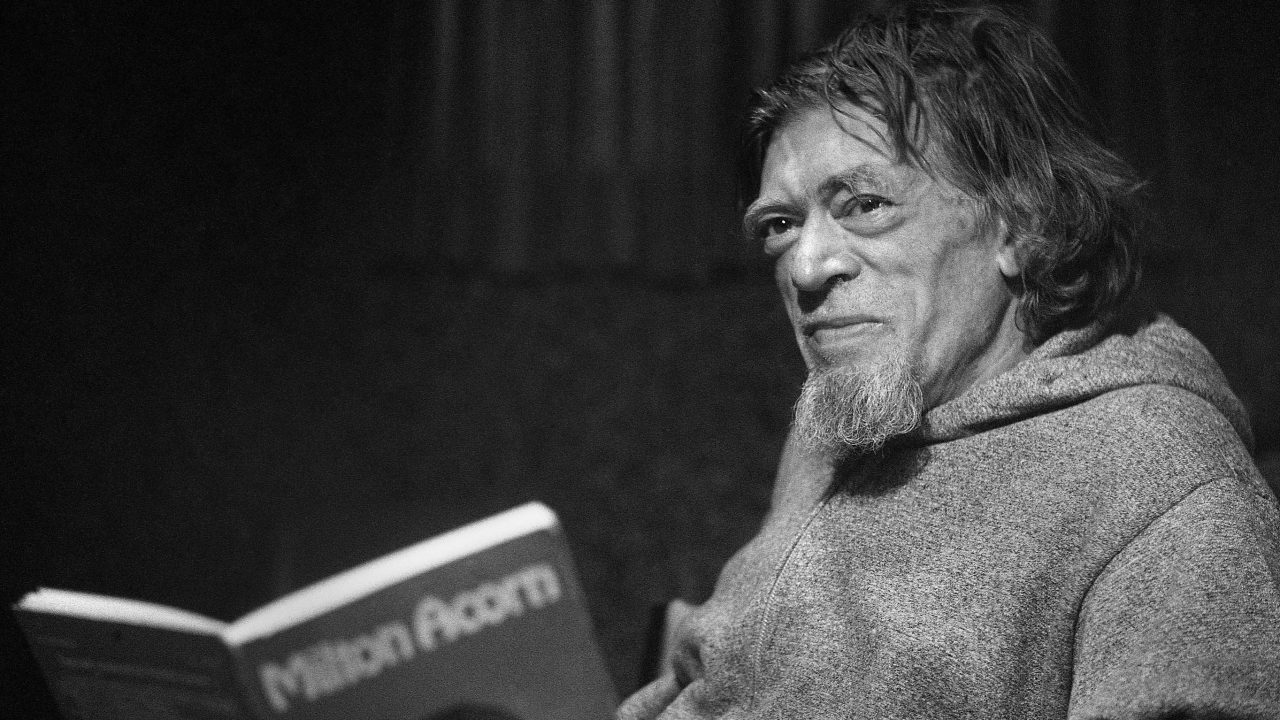
Milton Acorn Is Full of Poetry

 I've been reading Olivia Chow's amazing 2014 autobiography My Journey. So I woke up dreaming of my years in Toronto, and Milton Acorn. A review of Olivia's book will follow when I've finished reading it, but in the meantime, here's an old poem of mine about Milton.


Milton Acorn is Full of Poetry


even tho
you repeat yourself
thinking even your mumbles
are more important than
the truths of beginning poets

and even tho you've never even
acknowledged that I write poetry
you old fart

I am still a student of
THE MILTON ACORN SCHOOL OF POETRY
even if you are too
goddamned proud to open it

So the only way I could join
was to declare it
OFFICIALLY OPEN
in this poem
So here it is, Uncle Miltie

And even tho I've said
a nasty thing or two
in this dedication
More Poems for People is still
the only book I read often enough
to hide my money in

from my book Foot Through the Ceiling
1986, Aya Press
it won the inaugural Milton Acorn People's Poetry Award in 1987

note 1: Milton did eventually recognize that I had some talent as a poet

note 2: The story of finding hidden money in More Poems for People is true. I can't remember which birthday, prob. circa the late 1980s, but I shook out a twenty dollar bill and went to Greenwood Racetrack.  

See original image


Tuesday, 8 October 2013

Milt's homage to Kenneth Leslie: Ron Dart


                                              Kenneth Leslie and Jackpine Sonnets
 
                               Kenneth Leslie, poet, wrote it long and strong-lunged.
                               For his duty, critics ripped out his tongue.

                                                                                              Milton Acorn
                       

 “Poem of One of the Poems for Which Kenneth Leslie was Damned”


Kenneth Leslie was one of the finest poets of the people in Canada in the 20th century. Leslie was from the Maritimes, like Acorn, and the publication in 1972 of O’Malley to the Reds & other Poems was Leslie at his political and poetic best. Leslie had been nurtured, when young, by the Song Fisherman Poets, Robert Norwood, Bliss Carmen and C.D. Roberts. Leslie achieved poetic stardom of sorts with his being awarded the GG Award in 1938 for By Stubborn Stars, and from about 1939-1949 he was at the forefront (more than most) in opposing American fascism and the anti-semitic mood (he lived in both Boston and New York in those years) that often accompanied such an ethos. Leslie was editor of Protestant Digest (later The Protestant) in the 1940s, and the magazine, at its apex, had about 50,000 subscribers. The film, God’s Red Poet: The Life of Kenneth Leslie (2008), tells the tale of Leslie’s engaged life and tells it well. Leslie returned to Nova Scotia in 1949 as the FBI, Herbert Hoover and Senator Joseph McCarthy turned up the heat on communist sympathizers. In fact, Life magazine in May 1949 listed Leslie as the only Canadian of fifty leading “fellow travellers” and “innocent dupes” who furthered the communist cause: other worthies were Arthur Miller, Albert Einstein, Aaron Copland, Leonard Bernstein, Norman Mailer, Charlie Chaplin, Thomas Mann and Langston Hughes.

Milton Acorn dipped his political and poetic bucket deep in the life giving well of Leslie’s life and writings. Jackpine Sonnets (1977) was published a few years after Leslie’s classic O’Malley to the Reds & other Poems and Acorn, again and again, doffs his cap to Leslie. Jackpine Sonnets begins with these words, “As Shakespeare would say—To the Onlie Begetter of these Poems”—Kenneth Leslie. The poetic missive begins, therefore, with a conscious indebtedness to Leslie, then hard on the heels of such a nod to Leslie is a quote from Leslie’s GG winning book, By Stubborn Stars: “I sail by stubborn stars. Let rocks take heed: and if I sink; then sinking be my creed”. There is a definite sense in which just as Acorn wrote More Poems for People (1972) as a building on the poetic-political life of Dorothy Livesay, Jackpine Sonnets stands of the shoulders of Kenneth Leslie. It is significant that More Poems for People was published the same year as O’Malley to the Reds & other Poems.

The first poem in Jackpine Sonnets is “By Still More Stubborn Stars” and it is, of course, dedicated to Kenneth Leslie. The sonnet is a hard driving and compact visionary poem that sums up what it means to be a poet of character and integrity, skill and wisdom, justice and insight. Acorn saw himself as standing in the line and lineage of Leslie (who had died in 1974). There is a distinct sense in which “By Still More Stubborn Stars” is a eulogy to Leslie that sums up his poetic and political.

The main essay in Jackpine Sonnets is ‘Tirade by Way of Introduction’, and in this article Acorn  tracks and traces the history of some of the main themes of Canadian poetry, the essential Anglo-Canadian romantic connection and the origins of the jackpine sonnet---again Acorn turns to Leslie as his mentor and guide in his discussion of the sonnet. Acorn had this to say about the role of Leslie:
 
                 When we come to the loveliest of our orthodox sonneteers, Kenneth Leslie, the battle
                 for the Canadian voice is being fought, and he is winning it…….In Leslie the jackpine
                 sonnet is already there; but he uses it inconspicuously and rarely, always wanting to
                 give his readers the impression that what they see is an orthodox sonnet, however
                 unorthodox the content.


There is many a fine historic insight in ‘Tirade by Way of Introduction’ but there can be no doubt that yet again Leslie factors large in Acorn’s rethinking of both the form and content of the sonnet. Both Leslie and Acorn are redefining the sonnet, being careful to remain with the historic sonnet roots, but making the jackpine more flexible as it bends and grows throughout the seasons and winds of time---the poetic form is more willow like, the content more radical. It is in this sense, using the sonnet as a metaphor into the poetic vision of Leslie and Acorn, we can see are profoundly conservative both are and yet equally radical.

Jackpine Sonnets opens with a poem dedicated to Leslie and building on By Stubborn Stars, and the poetic missive comes, almost, to a close with another poem dedicated to Leslie: “Poem of One of the Poems for Which Kenneth Leslie was Damned”. The poem that Acorn is alluding to is Leslie’s longer poem (O’Malley to the Reds) in O’Malley to the Reds & other Poems. “O’Malley to the Reds” is a well told poetic-political drama that deals with the miners of Princess Shaft, Moses Coady and the tensions between the hard line ideological left and the religious humanitarian left. There can be no doubt where both Leslie and Acorn plant their flag. Both Acorn’s shorter sonnet and Leslie’s much longer graphic and not to be forgotten poem highlight the obvious affinities between them as both align themselves with the religious humanitarian left---both are, in a sense, Red Tories of the highest calibre and quality.

It is virtually impossible to read Jackpine Sonnets (1977) without a feel for the life and writings of Kenneth Leslie. Leslie died in 1974, and O’Malley to the Reds & other Poems was published in 1972.
Jackpine Sonnets is both a eulogy to Leslie and is similar to Acorn’s More Poems For People (dedicated to Dorothy Livesay). There is a significant sense in which Livesay’s Poems for People, Leslie’s O’Malley to the Reds & other Poems and Acorn’s More Poems for People and Jackpine Sonnets embody the pure gold of Canadian Peoples’ political poetry.

Ron Dart        


                ~ ~ ~ ~ ~ ~ ~ ~ ~ ~ ~ ~ ~ ~ ~ ~ ~ ~ ~ ~ ~ ~ ~ ~ ~ ~ ~ ~ ~


Poems of Kenneth Leslie
 
Governor General's Award 1938

Introduction
  Kenneth Leslie is the son of Western Society , the father of Gloria Wenk and Grandfather of Brigid Wendover, my wife and mother of my two daughters, Heidrun Tara Arthursdottir and Dagbjort Dipa Arthursdottir. This statement may raise a few questions which I will not try to answer here. 
I met him, 1975, once in a Halifax hospital. He was paralyzed and unable to walk or speak. Not the man that one thinks of. There I met Nora, his wonderful wife, by his side. 
I have taken the time to scan a number of poems from a poem book he published in 1972, called O’Malley to the Reds & other Poems. 
I have also scanned some sheet music which includes Cape Breton Lullaby. 
Arthur Wendover 


ARNOLD SCHOOL TO HARVARD 
 
KENNETH LESLIE attended a one-room private school in Halifax, Nova Scotia, Canada, known as the Arnold School located near the famous Victoria Park with its magnificent statue of Robert Burns. He played Rugby and Cricket. He studied Latin at an early age. 
The school was conducted by "Duck" Wad-dell, the Haligonian version of the Irish hedge-schoolmaster, a never-to-be-forgotten experience. He graduated from Dalhousie University, then studied a year at Colgate Theological Seminary where he helped form the Socialist Club. 


Then he continued studies at Nebraska University (MA) and Harvard where he passed exams for Ph.D. but failed the lingual test. 
 
KENNETH LESLIE 
1074 WELLINGTON STREET HALIFAX, 
NOVA SCOTIA CANADA 
1972 
 
 
                   ~ ~ ~ ~ ~ ~ ~ ~ ~ ~ ~ ~ ~ ~ ~ ~ ~ ~ ~~ ~ ~ ~ ~ ~ ~

Available from Porcupine's Quill:

book photo Magnify

Typeset in Adobe Jenson. Printed on acid-free Zephyr Antique laid. Smyth sewn into sixteen page signatures with hand-tipped endleaves, front and back.

POETRY / Canadian
POETRY / General
ISBN-10: 0889843287
EAN-13: 9780889843288
Publication Date: 2010-03-01
Dimensions: 8.75 in x 5.56 in
Pages: 64
Price: $14.95
 

Saturday, 20 July 2013

Poems for People: Livesay and Acorn (Ron Dart)


Dorothy Livesay and Milton Acorn: Poems for People and More Poems for People - Review by Ron Dart


"I suppose all my life I have fought against obscurantism! For me the true intellectual is a simple person who knows how to be close to nature and to ordinary people. I tend to therefore shy away from academic poets and academic critics. They miss the essence.”
—Dorothy Livesay

“Dorothy Livesay began in this book (Poems for People) in the tradition of Canadian poets who dedicated their poems and their lives to the working class.”
—Milton Acorn

Dorothy Livesay (1909-1996) and Milton Acorn (1923-1986) are probably two of the most important public and political poets that emerged, read and wrote in Canada in the 20th century. Livesay and Acorn shared many of the same concerns, although, by trail’s end, they did go in different directions and hike down different paths. Livesay was a social democrat with some democratic socialist leanings. Acorn was a Red Tory with socialist leanings. Acorn returned to his Anglican roots near the end of his life, and Livesay moved away from her Anglican beginnings. Both poets were, though, concerned with writing to, for and about the people (and the struggle of the common person) in Canada and on the larger international stage. Both wrote in a direct, accessible and easily understood way and manner.

Livesay’s Poems for People (1947) was written and published just after Livesay was married and the ravages and brutality of WW II. Acorn’s More Poems for People (1972) was written and published in the midst and thick of the Vietnam War and a few years after Acorn had won the People’s Poet Award in 1970. This short essay will briefly touch on how both Livesay and Acorn wrote books of poetry from and to the people, and how their approach was different.

Poems for People is a small book, and it is divided into three distinct yet overlapping sections: 1) Poems of Childhood, 2) Poems for People, and 3) Poems as Pictures. The missive begins with a poem, ‘V-J Day’. This poem, in many ways, is a fine opening to the collection. Livesay reflects on how, as WW II was in its worst and most dreadful years, her future husband asked for her hand in marriage. This ‘seemed a poor thing to do’, and yet they did it. Life was affirmed in the midst of death and carnage. Poems for People begins in this rather simple yet insightful way.

Part I, ‘Poems in Childhood’, takes the reader into both Livesay’s childhood (and how she interpreted some of the hurts and harm that came her way in this period of life), and poetic reflections on children. Spring and day has a way of breaking through the coldest winter and the darkest night. This is not a book of sentimental poetry. There is ‘winter wisdom’ in it, and such wisdom only emerges from living through the bleakest moments inside the soul and society. The early years must, inevitably, be left behind, and Livesay has a most inviting and meditative piece on the suffering Christ, ‘Inheritance’, to move the collection forward. ‘Inheritance’ stands in stark and striking contrast to ‘Preludium’ in which there is this optimistic and upward growth and development of humanity. The liberal notion of progress faces the Christ of the Cross. Who has the deeper truth and winter wisdom? ‘Point Counterpoint’ touches on the longing to meet and real friends, soul friends on the journey, and how we tend to create such imaginary friends if we do not have the real thing. ‘The Mother’, in a poignant manner, reviews and ponders the meaning of what it is like to be a mother and the many demands of each day on such mothers. ‘Small Fry’ is a fine companion to ‘The Mother’. The life of a small child, a small fry, brings together mother and child in a most compelling and attractive way.

‘The Inheritors’ walks the reader into the tensions and struggles of the First Nations people and the deep beat in the soul of such people that cannot be stilled, silenced nor erased. ‘Abracadabra’ is put together as a nursery rhyme, but it is a nursery tale thick with much meaning and import. ‘Carnival’ is much the same. Life is like a carnival with all sorts of amusements, distractions and diversions. The question for the little boy is this:

How do we prevent ourselves from being so mesmerized by the carnival that we forget where the open door is to real life? Part I, therefore, is about beginnings, struggles aplenty, family life and the many diversions that can distract us from the important and substantive things on our human journey. What, then, are those important things that we must face if we are ever going to live a meaningful human life?

Part II, ‘Poems for People’, takes us from the world of childhood, domesticity and the struggles of the inheritance of suffering offered to us by the Cross of Christ and the First Nations into the inheritance left from the wasteland of WW II. ‘Of Mourners’ points to reasons to mourn for all the children that will never live out their lives. ‘Letter from Canada’ cuts deep into the meaning and suffering of the war. Just as in Part I the Canadian wild geese were metaphors of freedom and hope, so, in Part II, the wild geese under the blue canopy offer hope when all seems dreary and dead. ‘Contact’ is a touching poem in which the longing for real contact with another is often denied, but the longing and hunger will not quit. ‘Sonnets for a Soldier’ and ‘Railway Station’ work on the same themes. There is leaving, there is loneliness, there is absence, there is death. How, in the midst of all this, can some sanity and inner quietness be found? Is it possible to find a still, inner peace and quiet when all is so frantic and chaotic both in the outer and inner worlds? There are two poems, ‘F D R’, and they are eulogies to Roosevelt. Livesay suggests that Whitman and Roosevelt might be true kith and kin. Many were convinced that it was the entrance of FDR and the USA into WW II that ended the war, and Livesay reflected such a perspective. The end of WW II ushered much of the world into the Cold War and the threat of atomic destruction and death. ‘Improvisations on an Old Theme’ ponders the potential end and fate of those who live in the Cold War ethos. Will they die a natural death or will the atomic bomb wipe them out? ‘London Revisited’ explores the London of the War years and the London that had come to life again. There had been violence and much had been destroyed, but there was life again. The city was rebuilding, and just as spring followed winter, so fresh and new life was emerging, Phoenix like, from the ashes of the War. ‘Matins’ is another poem, drawing from the Anglican cycle of prayer, that celebrates the beginning of a new day. Matins is the first of the Divine Offices, and just as London is being revived and rebuilt, the ancient cycle of prayer reminds one and all that each day is a new beginning. We are not meant to deny suffering, death and pain, but we can overcome such realities if we can see beyond them. ‘Lullaby’ is a warning poem. Let us not, as we enter this new world, be lulled into sleep by the carnivals and lullaby songs of those who would drug one and all.

Part III, ‘Poems as Pictures’, brings the reader to Canada and Wales. There are only four poems in this the final section. ‘Okanagan Pictures’ and ‘Pheasant’ are set in the Okanagan area of British Columbia. The scents, sights and sounds of the area in the day and night speak to and draw the poet. A silly pheasant almost loses its life in the Okanagan Lake, and Livesay ponders the significance of the meaning in such a near death. ‘Evensong’ brings us back to the Anglican meditative cycle of prayer. Rather than the Prayer Book being Livesay’s guide, the natural liturgical cycle of the day and the seasons become her guide and teacher. There is a song to be heard when evening comes and dusk arrives. Matins begins the day and Evensong winds it down. These ancient and time tried ways are brought into the rebuilding of London and life in the Okanagan. ‘Autumn in Wales’ concludes the poetic missive. Autumn will come, but in the coming, there is much that can be learned from religion, family, nature and history. Poems for People tells us as much.  

Milton Acorn won the ‘People’s Poet Award’ in 1970 for I’ve Tasted My Blood. Al Purdy wrote an introduction to the book, and this missive is a combination of poems (as expected) and short stories. Acorn’s two short stories in I’ve Tasted My Blood, ‘The Legend of the Winged Dingus’ and ‘The Red and Green Pony’ walk the curious reader into the compelling and attractive world of poetry, prose and short stories that were at the core and centre of Acorn’s literary vision. The publication of More Poems For People (1972) follows a similar format to I’ve Tasted My Blood. Most of More Poems For People is laden with poems, but there are three essays that speak forth Acorn’s vision in a not to be forgotten way and manner. ‘The Garbageman is Drunk’, ‘On Not Being Banned by the Nazis’ and ‘What are the Odds?’ tell their own convincing tales, in a realistic vein, about Canadian society and the fight for the Canadian way and identity in opposition to American imperialism.

More Poems For People (1972) was, consciously so, living out of the tradition of poetry from and for the people that Dorothy Livesay was so committed to and grounded in. More Poems For People is much less organized and structured than Livesay’s Poems for People, but both books of poetry are very much about the lives of the people rather than the high mucky mucks of society. There is more about Canada and Canadian political life in More Poems For People. Acorn, I think, was much more of a political poet than Livesay even though Livesay had many political themes in her poetry. There is also much more about Canadian people in More Poems For People than in Livesay’s Poems for People.

It is significant, perhaps, that More Poems For People begins with a long poem to Norman Bethune. ‘Bethuniverse’ raises all the big and challenging questions about medicine, being Canadian and justice. Norman Bethune, in many ways, was a model for Acorn of what the ideal Canadian could and might be, and ‘Bethuniverse’ says as much.  

Many are the tantalizing love poems in More Poems For People. Acorn was never shy in word or action about approaching the complex and often complicated nature of love and relationships. Nature is often used as a convincing landscape from which many of the love poems are shaped, formed and articulated. ‘Live with me on Earth’, ‘Already It Seems You Haunt this Cottage’, ‘To Rose’, ‘Come Live with Me and Be my Love’, ‘She Defines Herself Early’ and ‘She’, in a delicate and haunting manner, raise the questions about love, its possibilities and many deviations and distortions. But, the love poetry in More Poems For People is rather slight and meager when compared to the political poetry.

There is much more overt and succinct political poetry in Acorn’s More Poems For People than is Livesay’s Poems for People. Acorn is much more hard-hitting, blunt and to the point than Livesay. The poetry is still to and for the people, and to and against the high mucky mucks, but Acorn does not flinch or go soft where Livesay has a tendency to be more delicate and elusive. The heroes are held high in this slim volume, and the enemies are placed in the crosshairs. Bethune, Bobby Burns, Joe Hensby, Red Lane, Che Guevera and Ho Chi Minh are given the seats of honour and privilege, whereas the RCMP, the ruling class, insurance corporations, militarism, Ottawa and Canadian literary critics are taken to task. The political and love poems are scattered throughout this collection of poems, and Acorn takes his arrow from the quiver in ‘Ode to the Timothy Eaton Memorial Church’ and fires straight into the heart of an affluent and indifferent form of Christianity that seems to have forgotten its deeper core and centre.

The three essays in More Poems For People are hard hitting reflections on the Canadian fight for a nationalist vision, the liberal tendency to compromise such a vision, the colonial and comprador class in Canada and, most worrisome for Acorn as a poet, the way many Canadian poets ignore the hard economic and political questions. Acorn takes Rainer Maria Rilke to task for reducing poetry to an aesthetic mode that is quite harmless to those in power. Rilke, in some sense, becomes a metaphor for many Canadian poets. ‘On not being Banned by the Nazis’ ends with the gauntlet thrown down before the feet of many a Canadian literary critic and poet. I quote at length the final few paragraphs in ‘On not being Banned by the Nazis’:

"I now realize that what I meant was ‘Imperialist Academics’--such as Northrop Frye, who in the past did more than any other one man to abolish everything native and non-European in our literature. With the passage of Canada from a colony of England to a colony of Lower America (the U.S.A..) things have reached such a state that even imitation of imperialist models is frowned upon. American poets are sometimes permitted to think, sometimes say something of significance. Canadian poets must not, on the pain of immediate critical displeasure, even suggest they have a brain. B. P. Nicoll actually hides his good poems (for posterity one must presume), and published masses of garbage about some figure of his private mythos called Captain Canada. Nichol’s Captain Canada makes no sense, thus passing on the very esoteric message that Canada makes no sense. For this he has been awarded the Governor General’s Prize’.

"On an even higher place of dullness, as fertile as the mountains of the Moon—not those in Africa but on the Moon itself—stands George Bowering, personal puppet of Warren Tollman (whose name I might be mispelling but I don’t care) a ‘landed immigrant’ professor in B.C. who after fourteen years’ residence has never bothered to make himself a Canadian. Bowering’s poems have to be read to be believed…so incredibly bad, so filled with faulty observation, so marked by such an absolute lack of any sense of proportion or humour; that they, too, have gotten the ‘Governor General’.

"Bowering and Nichol are good colonial boys—without a thought in their heads which they will reveal. At least publicly they leave all thinking to their Imperialist bosses. People like these, and there are many like them, are what I mean by ‘academics’ although Nicol in fact has no university connection. Neither did Ezra Pound or Rainer Maria Rilke."

It is quite impossible to miss Acorn’s message in this essay. More Poems For People is about love, about politics and about those who demean and distort the message from the Muses. Frye, Nicol, Tallman, Bowering, Pound and Rilke come under heavy fire. Acorn’s longer essay, ‘What are the Odds?’ traces, in a historic manner, how Canadians, against many odds in the past, have emerged the victors. We are a people who have risen to many a challenge and stayed the course. Our present challenge is the American empire, and, for Acorn, the question is this: how can we overcome such an imperial opposition? We have overcome many odds in the past. Is it possible to do so again? Such is the challenge in ‘What are the Odds?’

There is no doubt that More Poems For People is not as organized or as tightly written as Livesay’s Poems for People, but what it lacks in organization and compactness, it makes up in political passion and probing love poems. Both Livesay and Acorn longed to speak to the people of Canada. Acorn did this in a more focused and political manner. Livesay did this in a more elusive, inviting and evocative manner. Both Livesay and Acorn are poets of the people, and both poets speak in a way that is accessible and vivid with the perennial themes of the human journey.

Acorn was very much indebted to the vision of Livesay, and those who follow in the tracks of Acorn and Livesay stand in a noble Canadian line and lineage. There were those like Ken Leslie, Archibald Lampman and Alexander McLachlan before them. There are those like Robin Mathews, Ted Plantos, Marya Fiamengo and James Deahl who follow them. May the tradition of Canadian political poetry ever thrive and flourish. May it also be given much more time, place, and public attention.

rsd


                      . . . . . . . . . . . . . . . . . . . . . . . . . . . . . . . . . . . .


On Sat, Jul 20, 2013 at 10:32 AM, Chris Faiers <zenriver@sympatico.ca> wrote:
Hi Anna,
Here's another of Ron's essays which I'd like to post. Can you please do the same thing with it & put it nside the body of an email?
many thanks!!!
p&p!
C&C Wrfffffffffffffff!

heading off soon to help at the Purdy a-frame - prepping for next weekend's open house & picnic