Total Pageviews

Showing posts with label Canadian sovereignty. Show all posts

Wednesday, 28 October 2026

Mark Carney: Hero and Villain

 This is the contradiction our Prime Minister poses. He is Canada's battlefield challenger in the sovereignty/trade wars with the U.S. But on the home front many of his policies, tailored to combat Trump's American imperialism, imperil Canada's long established domestic ideals. The Trumpian maga threat is real,  and Carney is a hero for being the first international leader to take strong and effective opposition to it.

 What will his legacy be when the maga steamroller has been derailed, in part through America's coming elections? Canada is currently forced to engage in international political triage, and the long term effects of this emergency will be crucial as they play out internally.   


Mark Carney is celebrated abroad – while he guts hard-won protections at home

Shiri Pasternak in The Guardian

The Canadian prime minister’s reckoning with Trumpism in Davos clashes with his attacks on environmental, Indigenous and labour rights

Image of Mark Carney, Canada's prime minister, speaks during a summer meeting of Canada's premiers in Charlottetown, Prince Edward Island, Canada, on Thursday, July 23, 2026. Carney said his government "will do whatever it takes" to defend Canada's interests against US President Donald Trump's latest tariff threat, CBC reports. Photographer: Kelly Clark/Bloomberg via Getty Images 


The Canadian prime minister is a hero around the world for his Davos speech that reckoned with a reconfiguration of power in the shadow of Donald Trump.

But at home, Mark Carney is mirroring the US president by radically centralizing power within his office and cabinet and taking a hatchet to dozens of laws protecting environmental, Indigenous and labour rights, all in order to enact his economic agenda.

His global sale of Canadian land and resources comes just weeks after another major Canadian export – wildfire smoke – decimated First Nations communities in northern Ontario, leading to mass evacuations and warning the world of the impact of a fossil fuel economy.

The Building Canada Strong Act, Bill C-39, is a 250-page piece of omnibus legislation introduced on 21 September by the transport minister and House leader, Steven MacKinnon.

The new bill expands his previous legislation that created an expansive fast-tracking designation for “projects of national interest” to “regions of national interest”, which could exempt vast areas of Canada from labour and Indigenous rights, and environmental protections.

Geographic regions can be given this sweeping new designation by federal ministers, diminishing the sovereignty of parliament and bypassing local elected officials and affected citizens in these special economic zones.

Arms-length environmental review boards are also being done away with. Decision-making for new pipelines, nuclear facilities, highways and other major infrastructure has been shifted to the very bodies charged with promoting these sectors. The Canada Energy Regulator now directly assesses energy projects, while the Canadian Nuclear Safety Commission directly approves nuclear/uranium projects.

Cabinet approval has also been removed entirely for most pipelines under the amended framework, now strictly reserved for pipeline projects requiring more than 300km of new right of way. Even if a significant pipeline is proposed, if it hews close to existing corridors, it is now exempt from federal cabinet oversight.

This is what Carney believes it takes to make good on his oft-repeated promise that Canada “has what the world wants”.

As Narwhal magazine reported, these changes follow lobbying by the oil and gas industry in the form of a literal wishlist of demands to speed up project reviews for fossil fuel projects. A public pressure campaign by the CEOs or executive chairs of 14 companies was released last March, calling on the prime minister to undo the former prime minister Justin Trudeau’s modest climate policies.

It is not only environmental protections that are impeding the economy Carney hopes will stabilize Canada’s GDP. The new bill also explicitly adds the power to end a legal strike in the Canada Labour Code.

For Indigenous peoples, the rollback is just as massive. They have fought for decades to constitutionally enshrine their rights to consultation on development affecting their lands.

But with fast-tracked projects and a new guarantee to industry of a one-year timeline for decisions, communities must determine all cumulative impacts in the early stages of assessment, virtually wiping out their opportunity to influence the project direction, given the time-consuming nature and costly nature of impact assessment.

What is the former central banker’s vision for Canada? To what image of nationalism is Carney hewing?

Carney’s approach has been called a “carve-out” system of legal exceptionalism. These aren’t the sensational executive orders of Trump’s bombastic political style, but more sophisticated and sly swipes at our existing framework of law.


Friday, 20 February 2026

Preparing for a Yankee Invasion: Charlie Angus


Forwarded this email? Subscribe here for more

One story, one act of resistance at a time.


Preparing for the Worst

Looking at the Canadian political spectrum, you might think that I’m at one end and Andrew Coyne at the other. However since the start of Trump’s resurgence, Coyne has stood out as one of the few voices in the Canadian press with a very clear-eyed view of the nature of the threat emanating from Washington.

So, needless to say, I paid close attention when I read the urgency in his recent opinion piece: Donald Trump wants to make an example out of Canada. How will we prepare?

“We are in a lot of trouble, and we need to move fast. There is no reason to confine our imagination to what is reasonable or even practical. It is not enough to hope for the best.

We have to plan for the worst.”

Coyne was writing about the fact that as much as Carney’s Davos speech inspired the world, it will have enormous political consequences for our relations with the United States.

Not only was Trump made to look like a fool, but Carney called on the world to defy the Project 2025 worldview. The speech has bolstered other leaders to begin standing up to the intimidation. The Americans view this as an act of insubordination or even rebellion.

Trump said as much at Davos when he warned Canada to be “grateful”.

“Canada lives because of the United States. Remember that, Mark, the next time you make your statements.”

The threat was unmistakable: Canada’s sovereignty exists at the whim of the gangster in the White House.

Economic retribution has already begun. Trump has threatened to shut the Gordie Howe Bridge and walk away on CUSMA.

A year ago, such threats would have rattled us and dominated press coverage. Now we seem to barely notice. Canada came through the first year of economic intimidation with surprisingly little pain. Trade with other nations has increased. There is a growing sense of national purpose.

And if Trump storms out on CUSMA, the government won’t be surprised. Plans are already being made.

So far, so good. But it is very dangerous to assume that this is the worst it could get. If economic threats don’t bring us into line, will Trump go further?

Recent polling shows that nearly 50% of Canadians believe that the United States could consider a military invasion of Canada.

The so-called “Donroe” doctrine has designated the entire western hemisphere as existing to serve the interests of the United States. Minister of War Pete Hegseth bragged that the U.S. has put aside legal and diplomatic “niceties” and is determined to create a world “governed by strength, governed by force, governed by power”.

Former UN Ambassador has warned that Canadians would be naive to think that our country is not on the “menu.”

Trump recently threatened force in Greenland but backed away because the European powers were forced to stand up to him. Will our allies stand up for us if Trump seizes the Gordie Howe Bridge?

Or if the U.S. military is sent across the border to help a staged insurrection at Coutts, Alberta? Or if a drone strike at the Nipigon Bridge paralyzes Canadian national trade?

I would like to think they would, but I wouldn’t take it to the bank.

Helping Canada out militarily would be much more difficult than sending ships and troops to Greenland. The Europeans are preoccupied with Putin. Canada might very well be on its own.

The Canadian military has begun war-gaming scenarios for a U.S. occupation and a Canadian insurgency war that would inflict “maximum casualties.”

A recent piece in The Atlantic, The American Military is Being Forced to Plan for an Unthinkable Betrayal, discussed the strategies of invasion being considered by the Pentagon. They warn that “attacking an ally would be a perversion of everything the armed forces were trained to do.”

Canada is hoping to establish our independent footing through a huge increase in military spending, but such retooling is a decade-long project. As Coyne notes, we don’t have the luxury of time.

I keep coming back to reports that the government is planning a 300,000-person volunteer force. So far, there has been little talk about how this force was created or deployed. But every day I meet Canadians who tell me they are more than willing to join up to defend our sovereignty.

I have been thinking a great deal about how a proactive civilian defence plan would work. This isn’t about getting seniors to march behind tanks in Belleville or telling folks to head to the hills with a can of beans and a rifle.

We need to give people a sense that it is possible to establish an all-of-society approach to protect sovereignty and democracy. This could be done by establishing a national network of local groups that are trained in civil defence and resilience.

Here’s what that could look like:

  1. Establish the volunteer force with the mandate to help communities whether in response to wildfires, floods or threats to sovereignty.

  2. Build from the bottom up. Decentralized local networks of resistance will foster esprit de corps and can respond quickly in the event of a local emergency.

  3. Draw on expertise already in our communities by involving health care and front-line workers, community planners, retired military and police.

  4. Invite the Canadian Rangers to play a role in establishing local training programs and consider a Junior Rangers-style program for our young people.

  5. Prioritize training in first aid, communications and logistics for use at the local level in case of emergency.

  6. Bring in Ukrainian trainers to help with drone skills and civilian-defence expertise.

  7. Conduct workshops in civil resistance in how national resistance can be undertaken by refusals to aid and abet an occupation.

  8. Give the local networks a strong social media presence to highlight local service and build national unity.

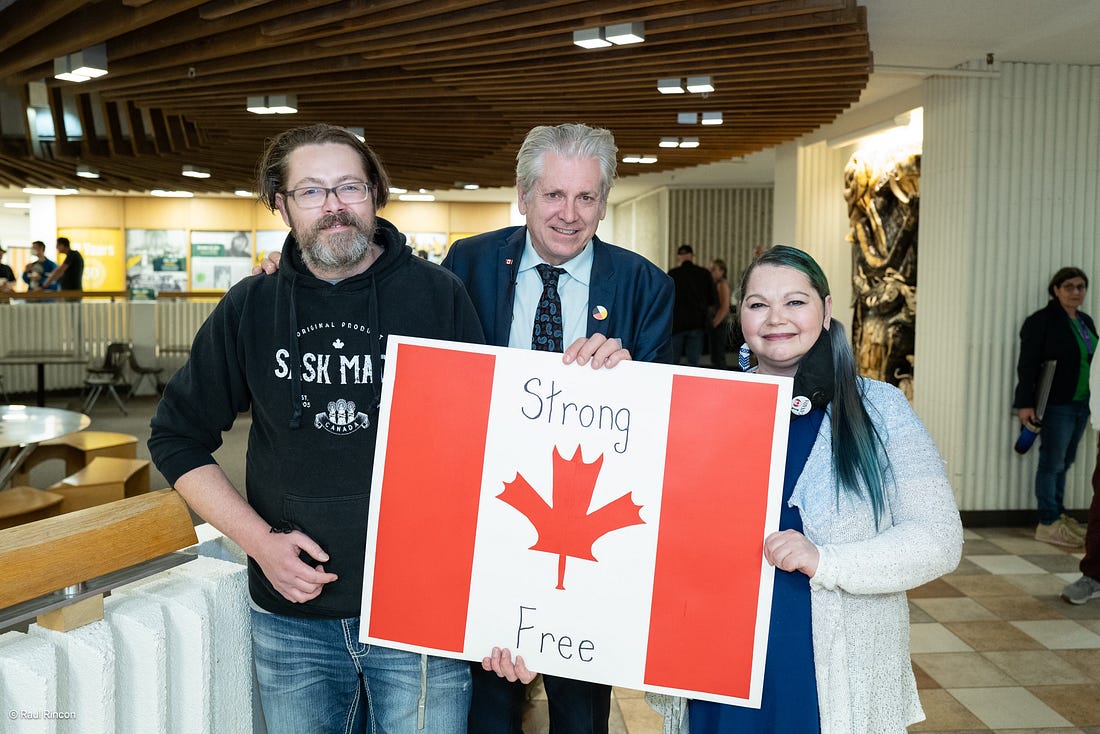
When I first started writing about these issues, I worried people might think I was being hysterical. But I agree with Coyne. It would be dangerously naïve to assume the best when we must realistically plan for the worst.

In doing so, we send a very clear message to those who doubt our resolve.

Canadians will never submit to a foreign threat. We will always govern ourselves based on Canadian values and law. And in preparing for the worst, we might just bring out the best in this beautiful nation.

Support The Resistance

·
AUGUST 13, 2025
Read full story

Charlie Angus / The Resistance is a reader-supported publication - please consider becoming a free or paid subscriber. Thank you.

This post is public — feel free to share it.

Share

Thank you for reading Charlie Angus / The Resistance. If you’d like to upgrade to a paid subscription your support will help keep this project independent and sustainable. I’m grateful to have you here - thank you for your support.

Unsubscribe