Total Pageviews

Showing posts with label Anna Yin. Show all posts

Monday, 2 March 2026

March with Icy Armour Repels Seductress Spring: Katherine L. Gordon poem


March With Icy Armour Repels Seductress Spring

Weary of winter I spread
a tapestry cloth of flowers
across the old dining room oak table,
a runner of tulip and daffodil baskets,
a place-mat of soaring birds, hand -stitched
winters ago by a yearning grandmother.
These soothe my longing for an end to cold and drear,
the hair-shirt of winter bleakness and fear.
I long to fill the silent skies,
finger-brush the imminent snowdrops,
hoping more for a kite than a canoe
to wind-whisk me from this barren ground up
to endless seas of skies more blue
than human consciousness can bear.


Katherine L. Gordon,   March 2nd. 2026.


Katherine, I wanted to have a spring graphic for your poem, but I didn't want to break copyright. So I used a pic from Anna Yin's website - hope she doesn't mind being our goddess of spring!  (it's the lavender dress)


Monday, 29 September 2025

fresh haiku and workshop updates from Anna Yin

 Dear Chris,


I trust you are well and enjoy a great weekend.

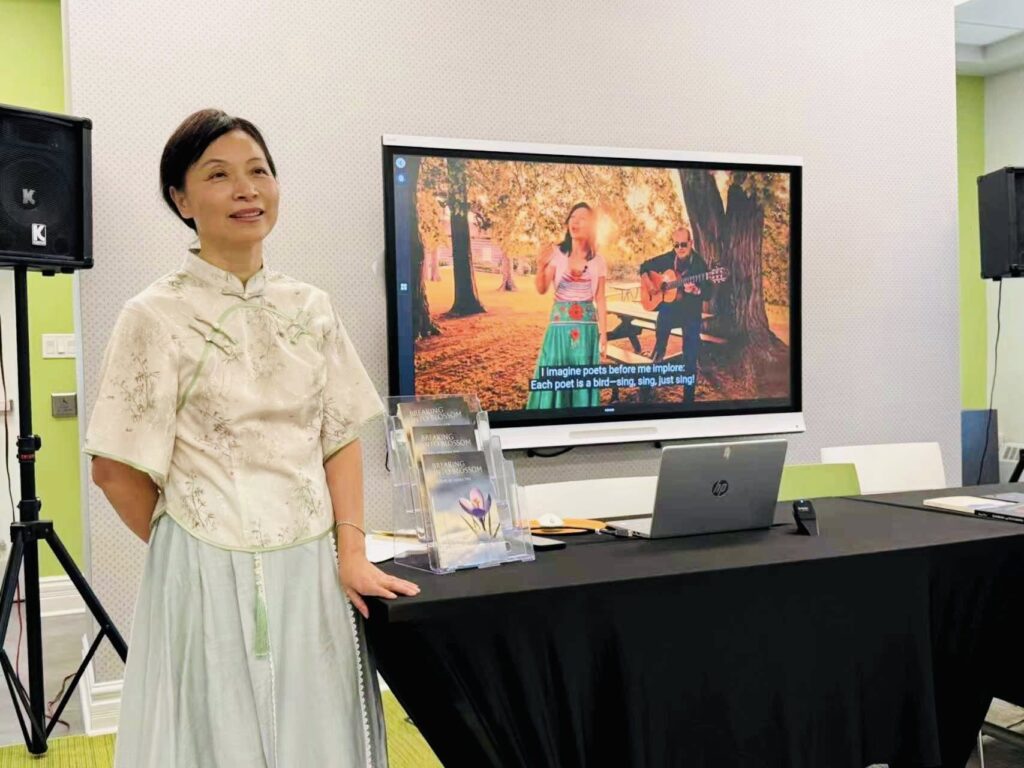
This weekend, I read my poems and showed Poetry and Music work at the Poetry for Health and Harmony event at Stratford Literary Festival.

I did the same for my haiku workshop event in PAMA (Peel Art Gallery) in Brampton.  I will visit two high schools in Oct. I plan to show a few works there.

During my haiku workshop at PAMA, I also wrote some haiku for the arts, I think you might be interested in them:


in and out
waves behind the trees
almost reach me
*

snowy dawn
walking to the market
mother’s warm hand
*

into this jail cell
echoes of another self—
no...no
*

Train history room
on the cycling tracks
a toy train hums
*

pause in the past—
scheduled train arrival
never again
*

all aboard
one after another
discovers haiku


Take care and keep writing. 


photo: Louise Liu

Sunday, 7 September 2025

Anna Yin arranges Katherine L. Gordon's poetry into YouTube songs

 Longtime poetry friends Anna Yin and Katherine L. Gordon have collaborated on a selection of YouTube videos. Anna used AI tools to bring Katherine's spiritual poetry to a vibrancy beyond the printed page. 

There are several more vids of their collaboration on YouTube. Search the blog for poems by Anna and Katherine.


Farewell to the Moon Men

https://www.youtube.com/watch?v=8GmED4HWxsQ&list=PLX1AAtT2GiktAScA39xdGcvgfGehora8i&index=2


MicroGrant Success: Anna Yin 2022 - Mississauga Arts Council


Tuesday, 20 July 2021

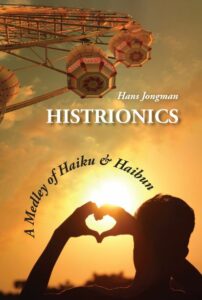
Histrionics: A Medley of Haiku and Haibun

See original image


 Review by Patrick Connors

One has to appreciate the wry sense of humor in the title of Hans Jongman's latest poetry collection. Histrionics are exaggerated behavior designed to attract attention. Jongman's work is very concise and reflective, clearly the product of deep contemplation and a positive self-image.

"What I like the most about the poetry is its unpretentiousness," said Chris Faiers. "Hans is an old master of the haiku form, so I should have expected nothing less than the best. But so many haijin have become arrogant and self-promoting these days that it's refreshing to read a collection which isn't trying to impress the reader, but rather presents great poetry without a lot of superficial blather."

Jongman begins "What It Is" with a short, anecdotal essay about a trip to see his doctor. From such an everyday experience, we gain insight into the author's reverie, and empathy for the physician. He follows the essay with this haiku:

a cold front
has cleared my sinuses
and the waiting room

"Haibun combines prose and haiku," Jongman explained. "The two disciplines compliment each other and equally deserve the same meticulous care for detail.

The haibun is the narrative, the story of a writer's personal experience complemented by a haiku, or multiple haiku. The haiku should not be a synopsis or reiteration of the preceding prose but should be reflective of the interrelationship between prose and the haiku. The haiku should stand on its own, on its own merit."

"Amsterdam" begins with a minimalist yet fascinating telling of the history of Holland's capital city. It's very pleasant to read, and very easy to visualize, although I have never been there. But the reader is startled into a further awareness at the end:

cloudburst
a thunderclap reverberates
between the gables

"My role was to make the book more balanced, to make sure it was laid out well," said Anna Yin, publisher of SureWay Press. "I made some recommendations with design which fit in with Hans' family history and personal experiences."

Yin made reference to Jongman's homage to the masters of haiku and haibun, and how much she appreciated it. "I published this book because it is very high quality. As soon as I read the poetry, I immediately loved it."

Jongman's final poem of the book, titled "Covid-19", is a fitting denouement both to this collection and the pandemic. It is a series of inter-woven haiku, done in a manner which only a master of the form could portray. I will not post any of it here, because I want you to get the book and seek it out for yourself. You will thank me later!

To order a copy of the book, please contact the author: hansjongman381@gmail.com

Thursday, 2 April 2020

Quarantine (Anna Yin)


Quarantine

  anna yin @2020/3/30

1.
behind the door
unreachable hugs ...
clouds float by the window
 

2.
night becomes longer
WeChat deferring
good night
 

3.
into a dream...
cherry blossoms bright
i think of you
 

4
rapidly increased cases...
straight line like the shortest distance
but the longest wait
 

5.
spring arrives with grasses green
and warblers seen, all noble or humble...
will God send mercy?
 

6.
waiting in silence
the cure for panic
except for poetry and a distance hope?
 

7
ups and downs...
who will light up
the far starry night?
 

8.
in the balcony
someone plays a saxophone
till dawn


poetryAlive-annayin3

Saturday, 26 December 2015

Christmas 2015 (Errol Sharpe)/The New Year (Anna Yin)


Christmas – 2015
Errol Sharpe

 
As I sit down to write this poem

My mind it does begin to roam

It’s files I sit and seek to comb

There’s not so much up in the dome


I know that up there much is stowed

Can’t seem to find the password code

I guess to many roads I’ve hoed

Should I dump some of the load?


But as I think there’s lots to say

So many they have lost their way

Their feet so often made of clay

My friends for them we all must pray


Refugees they come from far

Have no money, have no car

Are they running from the czar?

As they seek to heal the scar


In Canada we dumped the man

But does the new one have a plan?

For as across the land I scan

I just see another clan


The left it sings a mournful song

Its weak, its weak, not very strong

And as it muddles all along

It’s them not us who tune the gong


So we must sing another tune

Not wait my dear for a blue moon

For if we do not do it soon

I think that all of us will swoon


So come now people, let’s be brave

Dig us all out from the cave

A new direction we must pave

For this old planet we must save


Now as we look to the New Year

A new road we can help to steer

My friends we all must tune our ear

To a new path, a path that’s clear.


               ~    ~    ~   ~    ~


The New Year


This is a New Year poem made by you and me.

On a 12 month-long canvas, with its significant marks,

the horse year has rolled over:

Floats of the season spread seeds for flowers and fruits;

the great green land breeds rich cultures and thriving lives.

Children sing and dance along their everyday routines;

parents work hard to provide pleasure and prosperity.


From rural area to urban center,

new buildings rise and broad roads extend.

Through community to community,

diversity spreads and dignity is shared.

We paint joy and praise peace.

We respect equity and agree to disagree.


From time to time,

somewhere in the world, the sky is falling;

we extend our hands and spirits for support.

Here and there,

our passages are clogged with chaos;

we work together to create great fortune.

New forces gather and signal changes.

Our city and country are leading with promise.


This is a New Year poem.

It has been made by you and me.

On a 365 daily calendar,

each of us makes a difference

so that we can share love and enjoy peace;

each of us kindly contributes

so that together we all can celebrate.


As 2016 arrives,

another New Year poem will form.

It will be made by us.

Here is our land; here is our opportunity.

Together we will guard this land,

together we will build our great fortune.


Anna Yin/ Mississauga’s Inaugural Poet Laureate


2015/12/06


                           .   .   .   .   .   .   .   .   .   .   .   .   .


On Sat, Dec 26, 2015 at 10:46 AM, Chris Faiers <zenriver@sympatico.ca> wrote:
Thanks Errol ;  )-
Sentiments so many Canadians share. At least the dark clouds of the Harpy decade have been lifted, altho the electorate flocked like sheep from one traditional party to another. At least they flocked. I honestly thought Harper would enforce some national emergency law to stay in power, he's such a neo-fascist. Wait, that was Justin's dad who enacted The War Measures Act. arrgggggh!  (but a hopeful arrggh nonetheless).

Anna, would you pls send Errol's poem back inside an email so I can post it on Riffs & Rips?  - many thanks

best wishes to all for 2016!
Chris ... & Chase wrffffzzzzzzzzzz

p.s. look what you've started, Pearl   ;  )-


                                       .    .    .    .

THANKS ANNA!
That was quick ;  )-   your poem is very powerful & heartfelt - truly the Canadian vision for the future. I'm going to post it with Errol's poem - hope this is OK?
thanks again!
Chris

 
On 2015-12-26, at 10:51 AM, anna yin wrote:

Here it is and also my new poem to read at our city's Mayor Levee on Jan 3.


Monday, 20 April 2015

Poetry as Hope: Anna Yin on Shelley


Poetry as Hope

When I was young, Romantic poetry was very popular in China; we read the Chinese translations of Percy Bysshe Shelley’s poems. I remember that everyone liked to quote his lines: “O, Wind, If Winter comes, can Spring be far behind? “ We admired him as a passionate poet with charming lyrics and a revolutionary vision.
 

The online course THE GREAT POEMS SERIES SHELLEY founded by Eric Alan Weinstein is great and amazing. I believe it takes a lot of courage and effort to set up courses like that. In this fast-paced and cynical world, to teach and to learn Romantic poetry, especially long poems, presents teachers and students with extreme challenges. Most of us lack the patience and motivation for this. When I was preparing this talk, my fellow Chinese poets wondered if there was still an interest in this subject. They believe that Romantic poetry is out of fashion.

Preparing this talk gave me a great opportunity to distill my own thoughts and feelings. I think I have unconsciously regarded Romantic poetry as a timeless blooming tree; I find its roots and fruits are all over the Eastern and Western worlds. Many generations have not only been enlightened by the great ancient Chinese poet LiPo and the Persian poet Rumi, but also have inherited the light from Shelley, Byron and Keats.

When I started writing poetry, I initially wanted to improve my English and have fun. But it turned out that poetry helped me in discovering my inner world and opening up the great world of imagination. My book editor Terry Barker often relates me to the Romantic poets. I hesitated to admit this. I thought that although I looked optimistic and Romantic, in fact, for me, poetry was a way of escape.

When I read the biography of Shelley and his poetry, I could not help reflecting on my own poetic development, the necessity of my poetry journey and also its history. I have learnt that Shelley’s vision was altered over time by the influence of society, science, and other movements. From his first major work, Queen Mab, we can see that he believed that through educated optimism and a visionary approach, the world could be changed into an ideal world.

When we look back at human history, we can see that a lot of movements were initiated by similar thoughts and beliefs. For example the May Fourth Movement in China in 1919 and the Tiananmen Square protests in 1989. We can see that there was a similar idealistic motivation behind them. Like Shelley, young students cried out against the tyranny of all earthly authorities whatever. In Shelley’s next work, The Revolt of Islam, which is an idealized allegory of the French Revolution, we can see his vision has altered. He recognized that the world is not ready to receive the new order where the social law of love prevails until people can reform themselves from the inside out. This is true for China. The Chinese leaders know how risky it could be if a sudden change takes place. Like elsewhere, the reform must be from inside out.

Shelley understood that democracy has a long history and deep roots in Greek soil and Greek mythology. He would like to bring this light to the movement for European Liberty through his long poem: Prometheus Unbound. Yet, he had little faith in the dependability of the common man and he knew from experience too much about the limitations of the public intellect. For Shelley, the nineteenth century political outlook was not hopeless, however. Whatever poetry could do to enlarge the hope or dispel the darkness Shelley set himself to accomplish. Shelley hoped that his visionary poetry was like a mirror which had the power to make his readers admire his idea of divinity, and from admiring it they would imitate it, and from imitating they would identify themselves with the objects of their admiration.

Reading Shelley’s poetry, we can see the narrator is himself admiring the transcendent nature to identify himself with the object of his admiration. This esthetic process – the awakening and enlargement of sympathetic perception, the growing desire to imitate, and the willed development of imitation to the stage of self-identification, lies behind many works of the Romantic poets. They pursue poetry as a source of hope. They believe that that hope will change themselves and others. I remember Emily Dickinson once said “if I can stop one heart from breaking, I shall not live in vain”.

With this kind of hope, I think Romantic poets enriched not only their own lives but that of others too.


In A Defence of Poetry, Shelley explained that poetry acts to produce the moral improvement of the man. As he said, “The great secret of morals is love; the great instrument of moral good is the imagination and the great strengthener of the imagination is poetry.” Thus, poetry can become the tool to heal, to change and to transform. Shelley thinks “a poet is a nightingale, who sits in darkness and sings to cheer its own solitude with sweet sounds; his auditors are as men entranced by the melody of an unseen musician, who feel that they are moved and softened, yet know not whence or why”. As Shelley hoped: Poetry lifts the veil from the hidden beauty of the world. Poetry acts as hope to save the world.

I believe this includes today’s world.


                                  Bibliography

Baker. Carlos Introduction, The Selected Poetry and Prose of Percy Bysshe Shelley, (Ed. Carlos Baker), New York: Random House, 1951, pp (v-xvii)

 Anna Yin

                            ~ ~ ~ ~ ~ ~ ~ ~ ~ ~ ~ ~ ~ ~ ~ ~


On Fri, Apr 17, 2015 at 11:34 AM, Chris Faiers <zenriver@sympatico.ca> wrote:

Thanks for sending this, Anna  ;  )

You chose the best inspiration & mentor possible for becoming a poet when you chose Shelley!  I've always been a fan as well, & when I first landed in the UK in 1969 I toured the Lake District. I stayed at a youth hostel with other travellers, & one day several of use hiked to The Derwentwater & rented a row boat. Another day I went for a solo hike in the very hilly countryside. I wandered past a creek and small pond where trout were lazing between nipping bugs off the surface. Then I clambered up the scree of a small mountain (or very tall hill). At the crest I smoked some hash, & then sat in meditation. The legacy of the Romantic poets & the stillness of the Lake District did some magic, and in my stoned world I had the impression I was sitting with Buddhas past, present & future - each little mountain top had a sitting Buddha, and I enjoyed this satori until some passing hikers interrupted my reverie with, "Look, it's the Maharishi meditating." This brought me back to earth, or at  least back to my small mountain top, and I don't know that I've written about this experience since. It should have been a chapter or passage in EEL PIE ISLAND DHARMA perhaps  ;  )

Your piece reads well and true, & I'm know the audience will appreciate it. Following is a limnal* I did on Shelley in the first few months of my blog:

*limnal is a word I created, a composite of limn, liminal, hymnal and perhaps some other words  ;  )

peace & poetry power!
Chris ... & Chase Wrffffffffffffffffffff!  (we're going to visit Jim Christy in Belleville this aft & walk down the Moira River to the Bay of Quinte with  him)
Friday, 10 June 2011

Limnal to Shelley's A Defense of Poetry

(In writing this blog I've noticed how often I've referenced Shelley's brilliant essay from almost 200 years ago. To refresh my personal enjoyment of this great work, I've excerpted the following pieces and titled this homage a "limnal".)

In the infancy of society every author is necessarily a poet, because language itself is poetry; and to be a poet is to apprehend the true and the beautiful ... 

Every original language near to its source is in itself  the chaos of a cyclic poem;

Not that I assert poets to be prophets in the gross sense of the word, or that they can foretell the form as surely as they foreknow the spirit of events: such is the pretense of superstition, which would make poetry an attribute of prophecy, rather than prophecy as attribute of poetry. A poet participates in the eternal, the infinite and the one;


A poem is the very image of life expressed in its eternal truth.

Hence epitomes have been called the moths of just history; they eat the poetry out of it.


But poetry acts in another and diviner manner. It awakens and enlarges the mind itself by rendering it the receptacle of a thousand unapprehended combinations of thought. Poetry lifts the veil from the hidden beauty of the world, ...


A man, to be greatly good, must imagine intensely and comprehensively; he must put himself in the place of another and of many others; the pains and pleasures of his species must become his own.


Poetry strengthens that faculty which is the organ of the moral nature of man, in the same manner as exercise strengthens a limb.


The cultivation of those sciences which have enlarged the limits of the empire of man over the external world has, for want of the poetical faculty, proportionally circumscribed those of the internal world; and man, having enslaved the elements, remains himself a slave.

Poetry is indeed something divine. It is at once the center and circumference of knowledge; it is that which comprehends all science, and that to which all science must be referred.


... ascend to bring light and fire from those eternal regions where the owl-winged faculty of calculation dare not ever soar

... for the mind in creation is as a fading coal, ...

Poetry is the record of the best and happiest moments of the happiest and best minds.


... they (poets) can colour all that they combine with the evanescent hues of this ethereal world ...


It creates anew the universe,


The most unfailing herald, companion, and follower of the awakening of a great people to work a beneficial change in opinion or institution is poetry.


Poets are the hierophants of an unapprehended inspiration; the mirrors of the gigantic shadows which futurity casts upon the present; the words which express what they understand not; the trumpets which sing to battle and feel not what they inspire; the influence which is moved not, but moves. POETS ARE THE UNACKNOWLEDGED LEGISLATORS OF THE WORLD.

Percy Bysshe Shelley
1821


In 1981 bill bissett kindly published a collection of my poetry titled unacknowledged legislator
with his blewointmentpress
isbn 0 88971 044 9

Saturday, 23 March 2013

Poem by Anna Yin Saved a Life


After Reading Ted Hughes' "Full Moon and Little Frieda" (mp3) 
 
 
I fall in love with you, Moon,
seeing you step back like a timid artist.
Listening to the night,
you come out, a pail lifted.

Moon, they are gone.
They left you watching over the river.
How many years since?
And you watch the small village
becoming a floating island in the dark.
Among rows of windows,
the night flows, and I wide awake.

How much I want to imitate Li Po,
dancing with his white sleeves,
a hum from his burning heart,
night after night inviting you for a drink!
The wine never drained,
yet he drowned in the silver river.

Moon, lift your bucket,
come out once again.
I won't make a sound.

Anna Yin
  
Hi Chris,

Terry said I should send this to you and asked you to post this on your blog. Please feel free to do that. thanks.

Poetry Saved Me! http://www.annapoetry.com/?page_id=5523

Every Sunday I listen to CBC Radio One to hear Sunday Edition. Last Sunday I heard the story “Poetry Saved Me” and thought of something that had happened to me. In my book “Wings Toward Sunlight”(Mosaic Press 2011), I shared my story in the Acknowledgements, but I never knew that one of my poems could save another person’s life.

When World Poetry founder Ariadne Sawyer invited me to read my poems in Vancouver last summer, in her email she said “I have some news for you. There is an interesting story about your gift poem. ”  I wondered what kind of story that she wanted to reveal. On July 25 the poetry reading night in New Westminster library (B.C.), Ariadne shared the story with all the audience. She said that one lady called her to ask her to tell me, that she couldn’t come that night for my reading, but she wanted to thank me because my poem “After Reading Ted Hughes’ “Full Moon and Little Frieda” saved her life. She said that a few years ago she felt depressed and wanted to commit suicide, one day she wandered in a library and saw my poem on the wall. She read it then was hooked by its beautiful words and meaning. She found hope and abandoned her idea of suicide. I was very surprised and glad to hear the story. Poetry saved me, but from time to time I have struggled to find the meaning of writing poems and publishing them. At that moment I found it and felt so happy. I remember Emily Dickinson’s poem:

If I can stop one heart from breaking,
I shall not live in vain;
If I can ease one life the aching,
Or cool one pain,
Or help one fainting robin
Unto his nest again,
I shall not live in vain.

Later in China, Ms. Tang, a reporter From CCTV-4  interviewed me, I told her the story. She asked me: “How did my poem save her? What is her name?” I said: “ I don’t know.”  Indeed, I also asked myself the same question: How did the poem save her? It is a sad poem and tells two sad stories about two great poets(Ted Hughes and Li Po).

Yesterday I discussed it with my book editor and good friend Terry Barker about the Sunday Edition Program “Poetry Saved Me”. We read After Reading Ted Hughes’ “Full Moon and Little Frieda” again and again.  Then I think we found the reason. We both agree that although it is a sad poem, but in the end it lifts up. It invites the reader, the moon and these great dead poets to hang on… come back once more… this calling is very touching and authentic. Life might be short, but the beauty of living and poetry will last forever. So we think this kind of message gives hope and saved her life. Of course, each poem every reader reads differently. I am glad that my poem stopped one heart from breaking.


Thanks a lot.

--
Best wishes,

Anna Yin


读特德修斯的月亮 
月亮,我坠入了你的爱河。
看着你好似羞涩的艺术家
退回到夜幕里。
聆听着秋夜,你悄然
出来,手里拎着一个圆桶。
月亮,他们都已离去。
独留下你照看着
夜色里的长河。
多少年过去了?
你看着小小的村庄
成为漂浮的岛屿。
在行行的窗户之间,
黑夜流动,而我难以成寐。
我多想模仿李白,
依着他的长衫漫舞,
伴着燃烧的心轻唱。
每晚都来邀请你共饮。
美酒不会干涸,
而李白沉没在银色的河水中,
再也不见身影。
月亮,提起你的圆桶,
再一次出来吧,
我会安静得不弄出半点声响。
This entry was posted in English Poetry, Publish. Bookmark the permalink.

Sunday, 26 August 2012

The Only One - Anna Yin poem (commentary by Chris)


The Only One

I do know the silence
since I talk a lot in silence.
There are many colors in it;
I name each as my siblings.

But I am the only child.
I don’t have anyone to fight
or to accompany.
God says,
we are all the same, brothers and sisters.
But he too is lost,
and the lonely one.

As I walk with my shadow
I think of his journey.
I wonder
how could he carry all the burdens.

The road in front becomes foggy.

_________________


Best wishes,

Anna Yin

~ ~ ~ ~ ~ ~ ~ ~ ~ ~ ~ ~~ ~ ~ ~ ~ ~ ~ ~ ~ ~ ~ ~ ~ ~ ~ ~ ~ ~ ~ ~ ~ ~ ~ ~ ~ ~


Welcome back, Anna  :  )

I'm pleased to hear your trip was enjoyable and that the poetry interview in China went well.

Yes, PurdyFest #6 - AcornFest - was fun and yet another great "vacation for poets"! (thanks for coming up with this definition - it's making my life much easier when I try to explain the fests as briefly & accurately as possible).

And I really like your poem. It seems somewhat of a new direction for you (?)


(use of humorous self-deprecation)

I love the metaphysical irony and self-deprecating humour of "since I talk a lot in silence" - to me it sounds like you are becoming increasingly 'Canadianized' in your use and understanding of humorous self-deprecation in your poetry - this is a major, maybe predominant, Canadian personality trait. The best Canadian poets use this to strong effect - esp. Al Purdy. Milt also used this in what I consider his most humanized poems, like "Riding with Joe Hensby" or "I'll become a statue to myself". A little self-parody in poetry goes a long way to making poetry accessible - perhaps it should be considered a key aspect of People's Poetry.


(spiritual viewpoints: Christian/Buddhist)

Another new (?) aspect in your writing is a shift in your spiritual perspective (I could be wrong on this, as I don't know the body of your older work).

Our personal situations are possibly a mirror image, from what little I know of your spiritual & cultural background. You are from the East, China - the Orient, where the dominant spiritualities and religions are more internal, and yet I understand you are a practicing Christian.

I'm from the West, and was raised in that most traditional and establishment of Christian churches, the Anglican (or Church of England - same as Terry). I was a true believer and even the head altar boy until about age 15. Around age 14 I seriously began to question the sincerity of my fellow parishioners, including my parents and our priest. It seemed that no one either really believed or practiced what they claimed to believe at Sunday morning services.

I remember at age 15 driving to church with my parents and younger brother, and then climbing over a large wooded hill to a secluded lake. I found more spiritual sustenance roaming around the lake in a state of mild reverie than I had ever felt in church, even as a participant in preparing and serving the sacrament to the parishioners. Those Sunday strolls in nature likely became the early foundations for my later adoption of a nature oriented spirituality (like the romantic Lake poet Wordsworth) and which further broadened into a Buddhist awareness.

When I was 18 I became eligible for the draft for the American War in Vietnam. Even the popular media of the time exposed the hypocrisy and wrongness of the war, but I had to make and live by my own spiritual and social guidelines. I bought a used paperback on meditation to help me cope with a stressful schedule of attending college full time (while also working a 30 hour week - now this would be considered a full time job). I also had to commute several hours a day between school and work, and out of desperation with my situation I found a relaxing answer in practicing yoga.

The book also had some advice on breathing during the yoga asana poses, and some hints at meditative practices. I took to both yoga and meditation like a duck to water, and I've practiced meditation to some degree the rest of my life. It was also during this time that I discovered haiku poetry, and again I took to it as if continuing something begun in another lifetime (which I now believe).


(use of doubt in your poem)

Of course there is some minor history of the benefit of doubt in Christianity (Thomas Aquinas, etc.), but I find the point of view in this poem to be more Buddhist in outlook than Christian. The dominant theme is silence, and yet 'speaking' within this silence - sounds like meditation or 'true' prayer to me.

My understanding of Buddhism is that we all have a Buddha within, just as Christians supposedly carry the Christ spirit. But almost all the Christians I have met believe that God is somewhere OUT THERE, not primarily, or even at all, inside themselves.

But when an individual human is 'lost' in maya, 'worldly illusion', the Buddha within may be considered occluded (hidden, obscured). And this is how I interpret the conclusion to your poem, that in a Christian belief system there is just too much confusion for one God to deal with ("how could he carry all the burdens").

From what I consider an almost Buddhist perspective, you conclude the poem with the protagonist's  "The road in front becomes foggy".


It's a very strong poem, Anna, and the spiritual questing and questioning resonate with me and my belief systems. Well done!

peace & poetry power!
Chris ... and Chase ... wrffffffffffffffffffffffff! (get me outta here - you've been typing for an hour - time to head to ZenRiver for the day)


p.s. be interesting to hear what Terry makes of my interpretation
p.p.s. I'm cc'ing this to Marvin Orbach, a retired archival librarian who is collecting materials for the Univ. of Calgary special Canadiana literary collections - hope this is OK?


Monday, 30 July 2012

Informative article on Milton Acorn - Patrick Connors

In A Springtime Instant: Launch of Milton Acorn Anthology July 12


Patrick Connors – Toronto:  To commemorate the 50th anniversary of the Allan Gardens Free Speech Movement in July 1962, Mosaic Press and the Parliament Street Public Library are sponsoring an evening in remembrance and celebration of this important cultural and political event in Toronto’s history.  It will be held this Thursday, July 12, from 6:30 to 8:00 PM.

The library will host the launch of the new selection of poems by Milton Acorn: In A Springtime Instant. Acorn, who also read with his people’s poetry colleagues at the library, spearheaded the free speech struggle in Allan Gardens in the summer of 1962.  He courageously read his politically and socially charged poetry to large crowds in front of Robbie Burns’ statue in the Gardens.  Along with other Toronto poets and cultural figures, such as Joe Rosenblatt, he was able to change Toronto by-laws, allowing poets to read their works in Toronto parks without penalty.
“Milton Acorn was a bardic prophet to those sprouting poets like myself and others who came under his influence in the early sixties,” said Rosenblatt.  “He composed poems about proletarian individuals he knew personally; fishermen, union organizers, miners, while referencing his tangential musings to the boss carpenter, Christ, while he shouted love as a class war versified weapon of mass destruction against the bourgeoisie, when all the while he bruised easily on another theatre of war, tough love. How to classify his muse? I say don’t!”

All poets are invited to share their favourite poem by or about Acorn during the afternoon visit to Robert Burns’ statue in Allan Gardens between 4:00 to 5:00 pm.
The evening program will feature a talk on Acorn’s literary contribution by long-time Acorn friend and editor of the new book James Deahl, a background to the Allan Gardens issue by Humber College teacher Terry Barker, poetry about Acorn by poet Anna Yin, music by Toronto artist Honey Novick, and readings of Acorn’s poetry.

Anna Yin (Photo Credit: Jeannine Pitas)

“Anna Yin was a great help technically throughout this project,” Barker said.  “She is going to her native China for a visit shortly afterwards.  Her publisher is also Mosaic Press.  Howard Aster of Mosaic has a long history with China, and we are hoping for this to be an opening for Milton.
“She had never heard of Milt, as someone not from Canada, as well as a member of the younger generation, until I introduced her to him, as it were.  Hopefully she can introduce a new generation to his poetry.  She is attracted to the people’s poet aspect of Acorn.  Different people are attracted to different aspects of him.

“Similarly with Chris Faiers, whom I’ve known since 1973.  He has stayed with an interest in Acorn and haiku poetry, and developed other things alongside which fit into it.  He is interested in the mystical/spiritual side of Acorn.”
According to an e-mail sent by Deahl on June 14, the Milton Acorn feature he edited for Hamilton Arts & Letters has been read by over 10,000 people from 23 countries.  Canada was the top reading country, while Toronto featured the third most readers by city.  For this many people from this many countries to read anything about a poet, let alone a Canadian poet, is remarkable, and speaks even further to Acorn’s appeal.

Special guests will be include Acorn biographer Chris Gudgeon, as well as scholar Joyce Wayne, another friend of Acorn’s.

The Parliament Street public library is located at 269 Gerrard Street East, at the corner of Parliament Street.  Their phone number is 416-393-7798.  The Acorn event will be held in the upstairs meeting room, and will have light refreshments.
“Acorn is very important in the Canadian canon,” Barker said.  “Large numbers of writers from that era were indirectly influenced by him, as well as Gwendolyn MacEwan, whom Milt was married to for a short time.
“The circumstances of his life and personality made him difficult to situate.  He dropped out of, not favour, but knowledge.  Prior collections are out of print.

Terry Barker (Photo Credit: Jeannine Pitas)

“He lived what he wrote about.  He did go into the world and experienced part of the things he was interested in.  Physical and pshycological problems made life difficult, for him and also for those around him.  This made it harder to acknowledge his contributions.
“Socialism is no longer an issue, Canadian independence is no longer an issue, as these were issues in Milt’s time.  But perennial topics such as a critique of modern society, including the “advertising rainbow” he spoke of, certainly are.

“This parallels in thinking of Canada’s future as one potentially being run by a technocracy.  As a thinker, a poet is someone who should deal with these thoughts and the issues which arise from and write about them.”

For more information on the book, please go to:  www.mosaic-press.com
 With files from Chris Faiers
Friday, 11 May 2012

~ ~ News on PurdyFest #6 = AcornFest ~ ~


This summer's Purdy Country Literary Festival is named AcornFest in honour of Canada's People's Poet Milton Acorn. Events will take place over the August holiday weekend, beginning on Friday, Aug. 3rd. 

                                  ~ ~ ~ ~ ~ ~ ~ ~ ~ ~ ~ ~ ~ ~ ~ ~ ~ ~ ~ ~

Update on Hidden Brook Press anthology launch from publisher Tai Grove:
Hi Chris

I just heard back from Bruce Kauffman the editor of the north shore anthology that will present at the Purdy Acorn Fest

He sent out an email to all of the authors and he got a YES reply from 40 saying that they are going to come and read. That is aside from the CCLA reading.

Let’s hope it is sunny again
 
For your promo info you can put – Authors will read from the North Shore Series anthology, That Not  Forgotten published by Hidden Brook Press, editor Bruce Kauffman. The almost 400 page book includes poetry and prose by some of the finest authors in the north shore geographic area between Kingston and Port Hope on the north shore of Lake Ontario.

Gotta run

bro

This message is being sent from
Hidden Brook Press, or the personal email of Richard M. Grove / Tai
109 Bayshore Road. Brighton, Ontario, Canada, K0K 1H0
writers@hiddenbrookpress.com  1-613-475-2368
www.HiddenBrookPress.com
 
                                        ~ ~ ~ ~ ~ ~ ~ ~ ~ ~ ~ ~ ~~ ~ ~ ~ ~ ~ ~


Directions to ZenRiver Gardens:

ZRG is located in the pioneer hamlet of Malone by the millpond bridge on the Upper Moira River.

From Highway #7 turn north at the flashing orange lights onto the DELORO ROAD (about 1 km east of Marmora or roughly 12 km west of Madoc traffic lights at intersection with Highway #62 north).

Follow the Deloro Road to the hamlet of Deloro (turn north, left, onto O'Brien Street when you reach Deloro). Continue thru the hamlet and continue along the Deloro Road about 5 or 6 kms until you reach the hamlet of MALONE. Malone is tiny, just several houses. Turn right onto MALONE QUARRY ROAD (dirt) and follow it a hundred yards to the bridge over the Upper Moira River.

The millpond is on the right (west) side of the bridge, and ZenRiver Gardens is on the northeast side of the bridge. There are prayer flags, the rainbow-hued Jimi Hendrix treestand, etc. which make ZenRiver Gardens pretty obvious!


                      >>>>>>>>>>>>>>>>>>>>>>>>>>>>>>>>>>>>>>>
   

Timetable

Free rough camping begins at ZenRiver Gardens several days before the more organized activities. There is an outhouse, campsites, firewood & the river - the rest is up to the campers.

'Formal' events begin late Friday afternoon, Aug. 3rd, with the POTLUCK SUPPER. Bring what you wish (fast food welcome, home made preferred, chips-dip-snacks appreciated). The Friday nite campfire/reading is not to be missed ...

On Saturday professor/philosopher Terry Barker hosts the SYMPOSIUM on Milton Acorn (coinciding with the publication this year of the new selected of Milt's work, IN A  SPRINGTIME INSTANT James Deahl, editor, Mosaic Press, publisher). The Symposium runs from 12:30 to 2:30 pm in the William Shannon Room of the Marmora Public Library (by the only stoplights in Marmora!).

Later in the afternoon local musician/singer Morley Ellis will kick off ANOTHER DAM POETRY READING on the islet in the Marmora Dam (less than a 10-minute walk from the library - through the Lions Park and along the paved riverside walking trail). Most years CELEBRATE MARMORA coincides with our festivals, and there will be booths selling food & local produce, as well as face painting for the kids, etc. in the park. In the evening a traveling Shakespearean company performs in the park.

The ANOTHER DAM POETRY READINGS are very freeform & democratic. Poets read one poem at a time, round robin style, around and around the blankets and lawn chairs on the islet, until everyone has read/said/performed everything they wish to. Musicians & singers welcome! This can last from an hour+ all the way until dusk ... Morley energetically kicks things off with his broad repertoire of songs and singalongs  around 3:30 pm - leaving time for a snack & a wander thru the park displays after the Symposium.

On Sunday afternoon Tai Grove wears two hats. First as President of the Canada-Cuba Literary Alliance (CCLA), Tai will host a group reading by CCLA members at ZenRiver Gardens. Then he'll don another hat as publisher of Hidden Brook Press and host a reading by poets included in his latest HBP anthology, THAT NOT FORGOTTEN. Readings are anticipated to start after lunch - maybe 1 - 2 pm? (people will be tired after several nights of camping & Saturday's featured activities).

                                               
                     >>>>>>>>>>>>>>>>>>>>>>>>>>>>>>>>>>>>>>>>

Recommended Area Activities

Although not specifically scheduled or promised, on the Holiday Monday festers often make the hour drive to Ameliasburgh to visit Al Purdy's grave and his historic A-frame cottage.

There are also many beautiful spots near Marmora, including Callahan's Rapids Conservation Area. Last year a gang of festers spent an afternoon wading upstream in the Crowe River in this magical spot. Poets have also visited Petroglyphs Provincial Park, a sacred First Nations spiritual teaching area, and Bon Echo Provincial Park, another sacred First Nations shamanic locale.    


As poet Anna Yin so aptly noted last year, PurdyFests are vacations for poets. You will be inspired, we promise!


peace & poetry power!
Chris Faiers/cricket  ... and Chase, my shih-tzu familiar on steroids ...WRRROOOOOOOOOOOOOOOOOOOOOF! (welcome to AcornFest!)


keep current on AcornFest at the blog Riffs & Ripples from ZenRiver Gardens:

http://riffsandripplesfromzenrivergardens.blogspot.com/


~~~~~~~~~~~~~~~~~~~~~~~~~~~~~~~~~~~~~~~~~~~~

Anthology of PurdyFest poetry????

Yes, brother Junebug,
James suggested this after the first PurdyFest ... I've got some poems in the annual PurdyFest files, & I'm sure if we sent out the word, we'd be inundated!

p.s. also perhaps poems inspired AT ZRG and PurdyFests - might make for a broader list of topics (e.g. Stan White wrote some intriguing ones about the early inhabitants of Malone hamlet)

p.p.s. and perhaps also poems READ at PurdyFests (thinking of CCLAers, etc.)

(To start spreading the word, I'll put this on my blog on the announcement for AcornFest)

                                           ........>........>.......>

On 2012-05-12, at 12:32 AM, Richard M. Grove wrote:

Hi Chris

I think we should spread the word that one day – when there are enough poems we will publish a collection of poems about ZRG. You have enough poets visiting year after year that there should be enough for a book one day.

bro


~~~~~~~~~~~~~~~~~~~~~~~~~~~~~~~~~~~~~~~~~~~~~