Subject: my 2 1969 booklets: first chapbook collections of Canadian haiku (?)
email Sept. 9/12
Hi Marvin,
Great to hear from you - you sound well & in good spirits : )
As always, I'm pleased that you are finding a good, permanent home for all these poetry-related items and ongoing communications. I'm trying to be selective in the emails I copy you on; I don't want to send anything which would compromise another writer's privacy, & yet I want to give future readers & literary historians an inside view of the day-to-day life of Canadian poets and how we interact among ourselves, our publishers, our non-literary friends, and of course the readers (who of course are mostly other poets and academics anyway).
~ ~ ~ ~ ~ ~ ~ ~ ~ ~ ~ ~ ~ ~ ~
I'm pleased with your request for copies of my two 1969 chapbooks, CRICKET FORMATIONS and GUEST IN A GARDEN (or I AM A GUEST IN A BEAUTIFUL GARDEN). I self-published these two collections in the late summer and fall, months after I had moved to England to avoid the draft for the Vietnam War.
Both these chapbooks are quite seminal in the world of English language haiku, and they are very seminal for Canadian haiku. They are possibly the first collections of haiku by any Canadian haiku poet (haijin)
Eric Amann is generally acknowledged in the haiku world as one of the godfathers of modern English language haiku, and as Eric is Canadian, he is most definitely the godfather of Canadian haiku. In the mid-1960s it was Eric's magazine, Haiku, which promoted the form (and to a lesser degree the content) of modern English language haiku.
I've told the story of Eric's long distance mentorship and encouragement of my haiku elsewhere, including in my memoir, EEL PIE ISLAND DHARMA (about to be reprinted).
After several initial rejections of my first attempts at haiku, Eric began publishing my work in "Haiku". This was circa 1967/68, and I was in my late teens.
The style of haiku I was writing back then with Eric's encouragement, and which I continue to write to this day, has become the dominant and established style and content for modern English language haiku. This wasn't necessarily true back in 1969 when I published my two haiku collections, when many or most haiku poets were still writing stiff and formulaic haiku, often in the strict 5-7-5 syllabic pattern. None of my haiku were (or are) 5-7-5s. Inspired and encouraged by Eric I worked hard to shorten the haiku form and content to better reflect what I believed to be the spirit of the Zen-inspired Japanese haiku masters.
Unfortunately I do feel to some extent the primacy of my early haiku work and publications has been overlooked among my fellow Canadian haijin, or more accurately, perhaps, strongly downplayed. The existence of my two early haiku publications, and their creation by an individual writer and haiku poet, perhaps runs counter to another version of the development of 'Canadian' haiku. This version of Canadian haiku might be described as group oriented - that first came Haiku Canada (originally THE HAIKU SOCIETY OF CANADA - founded in the late 1970s), and that out of this organization modern English (and French language) Canadian haiku developed.
The problem with this Haiku Canada historical narrative is that I had already - a decade earlier - published these two slim collections.
As you note, they are extremely rare. I'm not sure if I have even one copy of GUEST, but I'm sure I can find a copy of CRICKET FORMATIONS to add to the Univ. of Calgary special literary collections.
Thanks again for all you do for CanPo ... : )
peace & poetry power!
Chris/cricket and Chase ... wrfffffffffffffffffffffffffffffff!
p.s. I have donated a copy of CRICKET FORMATIONS and some other haiku materials to the Special Haiku collections at a Univ. in California
~ ~ ~ ~ ~ ~ ~ ~ ~ ~ ~ ~ ~ ~ ~ ~ ~ ~ ~ ~ ~ ~ ~ ~ ~ ~ ~
On 2012-09-06, at 9:23 AM, marvin orbach wrote:
Howdy Chris,
Just a short note to say hello. I trust that all is well with
you and that the reprint of your memoir is coming along fine.
I continue to receive copies of your recent e-mails. About a week
ago I sent off 3 packages to the Promised Land. These include all
your recent contributions, plus correspondence. They will be
preserved for posterity.
I must say that I enjoy reading Katherine Gordon's new poems that
appear in your blog. She certainly is a talented poet.
I wanted to ask you about your first two publications that you did
in England. I assume these contain poems. I checked Amicus, the
online catalogue that lists the holdings of thousands of Canadian
libraries. I couldn't find any listing of these two books. That
means no Canadian library has these two titles. If you have spare
copies, I would be happy to deposit them in my collection at the
University of Calgary, if they contain poetry.
The weather here is still unseasonably warm. I don't remember
such a hot summer.
I imagine Chase is doing well.
I must go now. Looking forward to your response.
I shout love.
Marvin.
~ ~ ~ ~ ~ ~ ~ ~ ~ ~ ~ ~ ~ ~ ~ ~ ~ ~ ~ ~ ~ ~ ~ ~ ~ ~ ~ ~ ~
On 2012-09-19, at 2:58 PM, marvin orbach wrote:
Hi Chris,
Your copy of Cricket Formations, your first book, arrived safely
in this morning's mail. Thank you very much. What a little
treasure this booklet is. I enjoyed reading the amazing haiku. Was
it by accident that your name does not appear anywhere, or was this a
Zen way of minimizing your ego? As far as I know the U. of C. Library
will be the first library in Canada to have this book. What an
honour!! It will head west with my next shipment.
I am looking forward to rereading Eel Pie Dharma when it is
reprinted. If you happen to have a spare copy of the first ed., and
you are wiling to part with it, I would be happy to deposit it into my
collection in Calgary.
Aye, we are all flowers!!!
I shout love.
Marvin.
* * * * * * * * * * * * * * * * * * * * * * * * * * * * * *
Hi Marvin,
I'm so pleased the copy of CRICKET FORMATIONS arrived OK. It is a real rarity, both for my work and in the field of English language haiku.
And of course I'm very pleased you enjoyed reading it ... Yes, it was youthful idealism, rather than youthful egotism or carelessness, which omitted my name from
the small booklet : ) ... and I'm glad I did it that way. There is so much overbearing egotism in the haiku/haibun world now, that it makes me pull
away from it most of the time. (but from time to time I try to assert myself and what I feel is my rightful place in the development of English language
haiku/haibun - the blog is a great way to chest thump!)
I wish I had a copy of the original EEL PIE DHARMA to donate. I don't have a single complete copy myself, at least that I can find.
I borrowed the line from James Joyce, but of course,
Aye, for we are flowers, all!
peace & poetry power!
Chris/cricket ... and Chase ... and MacDuff Wrrrrrrrrrrrrrrrrrrrrrrrrrrrf! Wrffffffffffff! Wffffffffff!
You have asked several times for some new haiku/haibun from me, so you can take substantial credit for encouraging the following, composed a few hours ago: "dog day afternoon haibun".
* * * * * * * * * * * * ** * * * * * * * * * * * * * ** * *


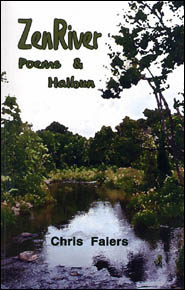


 Chris (Christopher) Faiers was born on Hamilton Mountain, Ontario, Canada in June 1948. He began publishing haiku in 1968 under the guidance of Haiku Magazine’s Eric Amann. He had an enlightenment at age 20. Cricket was his childhood nickname and is his haijin name.