Buoyant blog of septuagenarian (78) Kanadian poet and haikuist Chris Faiers/cricket. People's Poetry in the tradition of Milton Acorn, haiku/haibun, progressive politikal rants, engaged Buddhism and meditation, revitalizing of Callaghan's Rapids Conservation Area, memories of ZenRiver Gardens and Purdy Country LitFests (PurdyFests), events literary and politikal, and pics, amid swirling currents of earth magick and shamanism. Read in 119 countries last week - 43,329 readers in September.
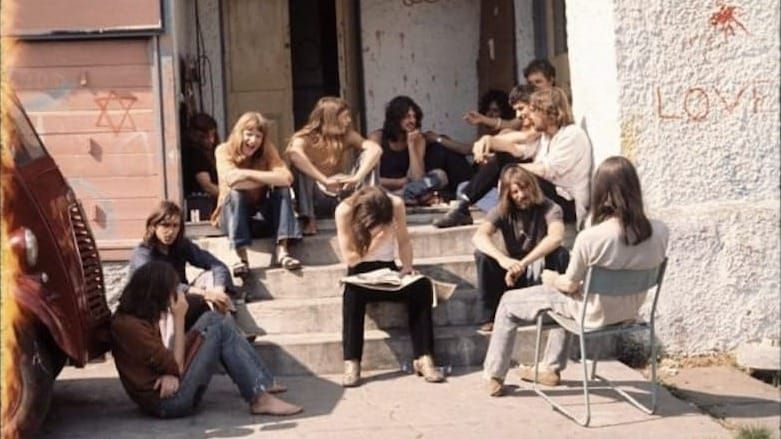
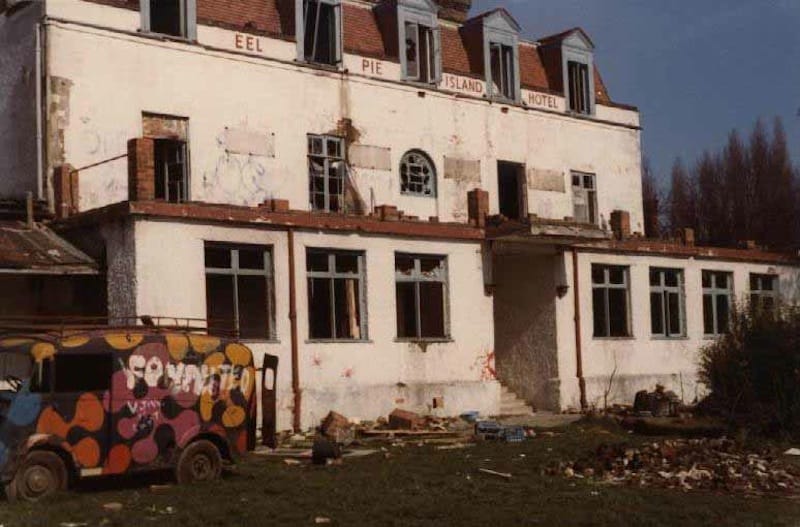
I'm chuffed as we said in the hippie days when I lived in the abandoned hotel on Eel Pie Island. British author Cassie Steward has just published a 500 page novel largely based on the experiences and freeform lifestyle of the residents of the hotel.
My Eel Pie Island Dharma is less than a fifth the length of Cassie's novel. It's a haibun/memoir, and my original intentions were to use the brief chapters as guidelines for a novel. But I came to feel the text worked perfectly as a haibun, and self published it that way in 1990. In 2012 Tai Grove published a far more professional edition with Hidden Brook Press.
I love it that EPID has now been used as the basis of Wild Summers, her fully fleshed out novel. Her main character is a 17 year old girl living in the poshest area of Twickenham. It's a great coming age novel with social outcast Joan Summers discovering herself through visits and friendships with the bohemian inhabitants of the hotel.
Here's the cover of her book against the backdrop of the current Eel Pie Island footbridge.
from Acknowledgments
Special thanks to the real Eel Pie Island posse, old and new: Chris Faiers,
haiku poet and author of Eel Pie Island Dharma. You and your book were
so integral to my research. You've been so generous with your time and so
supportive of this project. You feel like a faraway friend and I smile every
time your name appears in my e-mail box. The same to Weed, (the real Weed),
who also let me use his name for one of my characters (I hope you like him!).
To read for free the original 1990 text of Eel Pie Island Dharma click on the link at the top right hand side of this blog under links of interest: Eel Pie Dharma. It's basically the same as the text of the Hidden Brook Press pubication, minus the crucial intro and picture sections.
Yes, definitely do NOT forget the haiku audience, we are in the millions;-) On that note, looking forward to your next haiku to be selected for David McMurray’s newspaper column, the Asahi Haikuist.
David McMurray: Editor Asahi Haikuist Network
~. ~. ~. ~
British author Cassie Steward is using my haiku as an epigraph to her new book,Wild Summers. It’s about the Eel Pie era in London and features the Eel Pie Island Commune as a major location.
I also have another ask - you know how some books have a little quote/poem in the opening pages, before the novel begins? I was wondering if I could use a few lines of one of your poems? It would be fully credited with your name/etc. Just to capture the vibe of the book before it starts. I found these two, but perhaps you have another you think would be more fitting?
After cold midnight scraping burnt commune rice pot on the lawn for birds
Our Saturday stories are free for all to read — but we can only survive with your help (and we're currently being sued for £250,000 by a wealthy Airbnb grifter). If you're a fan of today's piece, please do consider becoming a paying member. And with our spring discount, it costs less than a fiver a month (for your first three months) to support us.
In the late 1960s, Chris Faiers was down and out in London. Canadian by birth, he’d grown up in North America and emigrated, like so many other young men, to dodge the Vietnam draft, after having received three notices in a week. When he walked into the offices of a local newspaper in Richmond to ask for a job, he was surprised when he was taken seriously – the editor gave him a test assignment, telling him about some hippies who had started a commune in an abandoned hotel in Twickenham. The hotel was on a little island in the middle of the Thames.
He caught the bus to Twickenham and found the footbridge which led to the island. “It was about two hundred feet across the little bridge, with a beautiful view of the Thames,” he writes in his haiku-laden, LSD-infused memoir, Eel Pie Dharma. “When I had reached the island I felt I had entered a special place. A footpath lined with neat little cottages wound through the centre of the island. There was no missing the old hotel at the end of the footpath. It was derelict, and I just walked in where the grand front entrance had once been.”
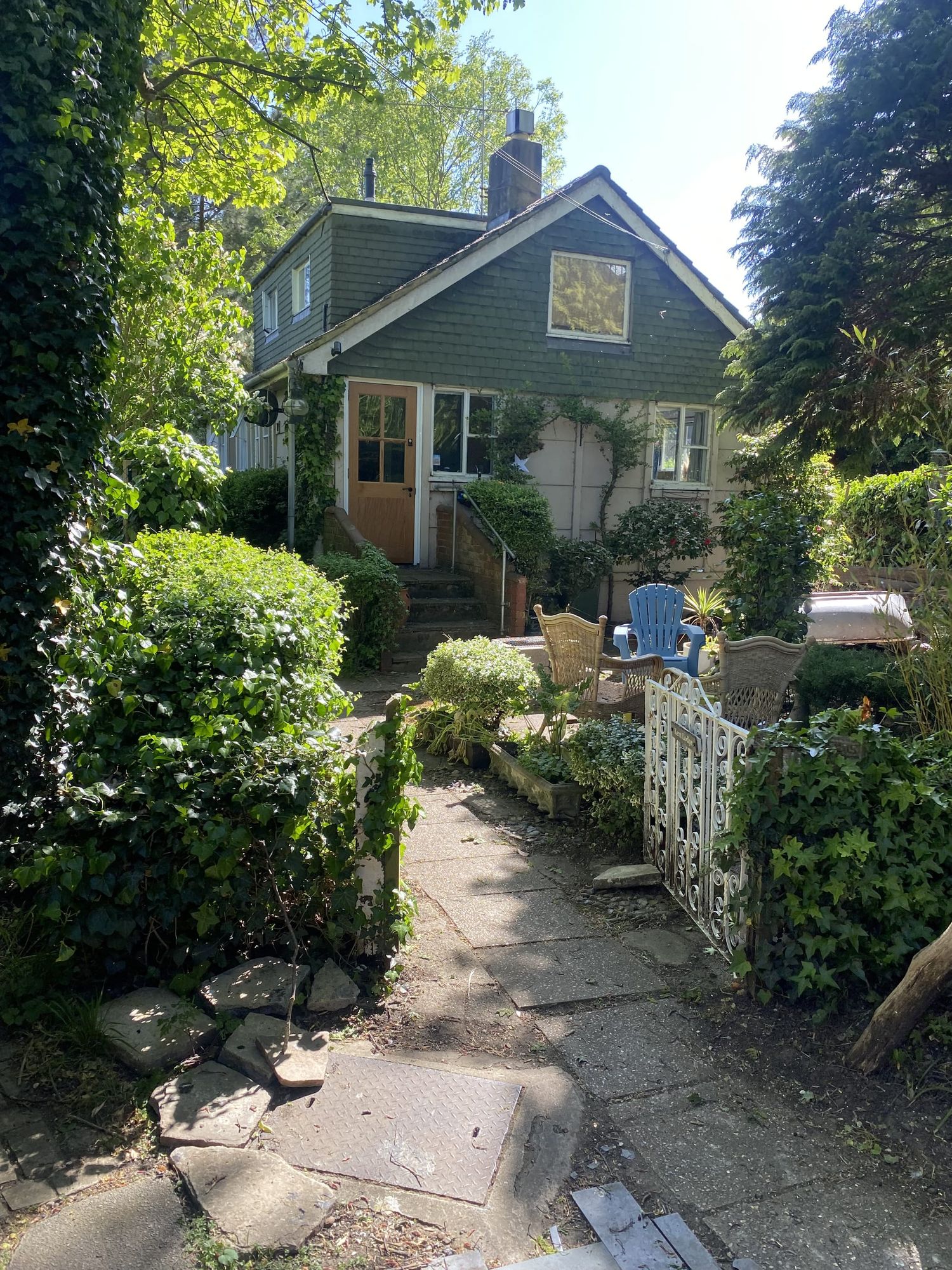
Faiers is right about the view. There’s something almost Scandinavian about it, from where Eel Pie Island connects to the Thames embankment at Twickenham via a humped iron bridge: thickets of dense greenery dapple the light over little corrugated iron houses, converted from boat stores, which hug the water’s edge. Some dwellings have their own jetties, all have pleasant garden seating areas and are a picture of idyllic outdoor living.
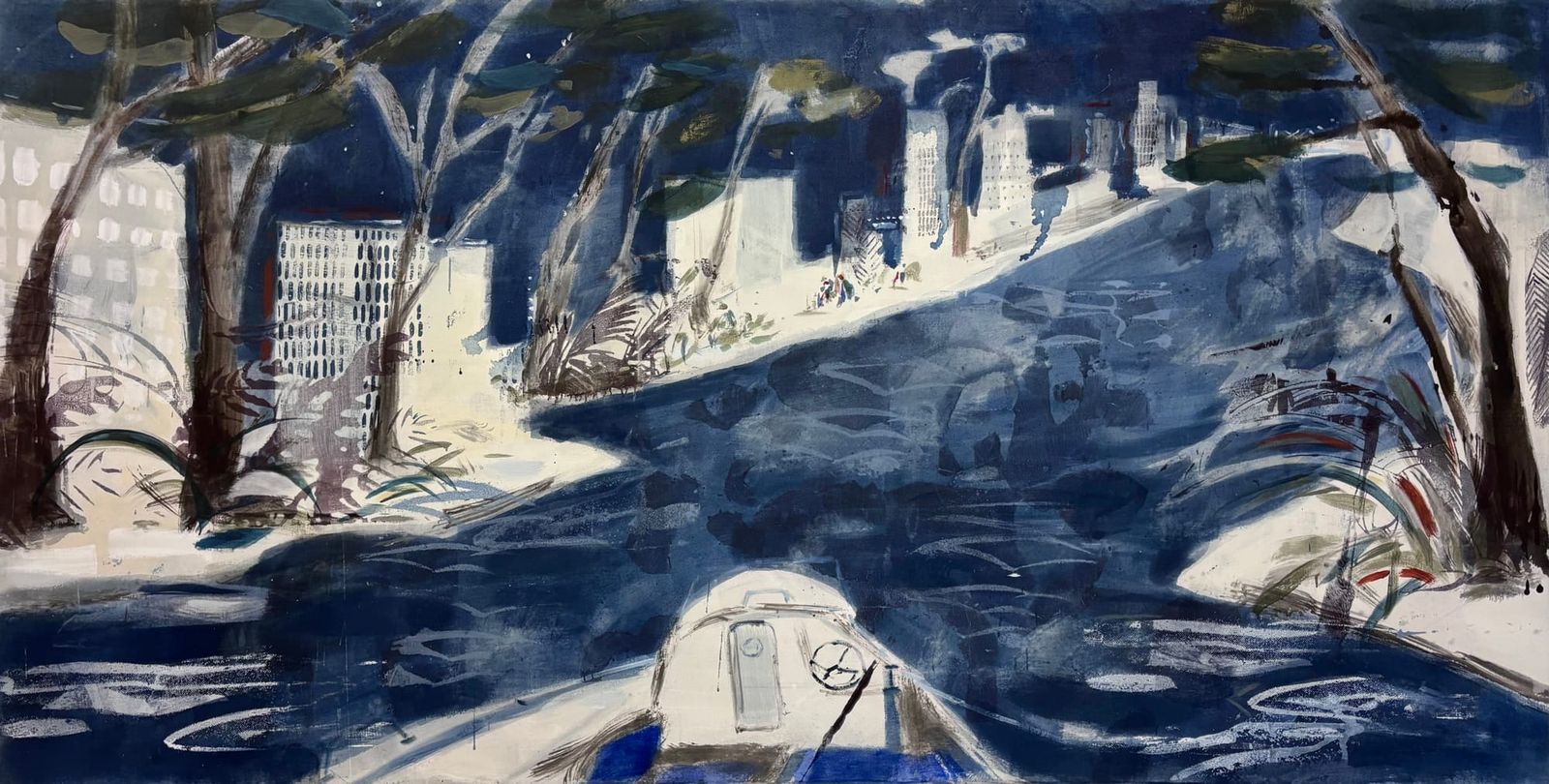
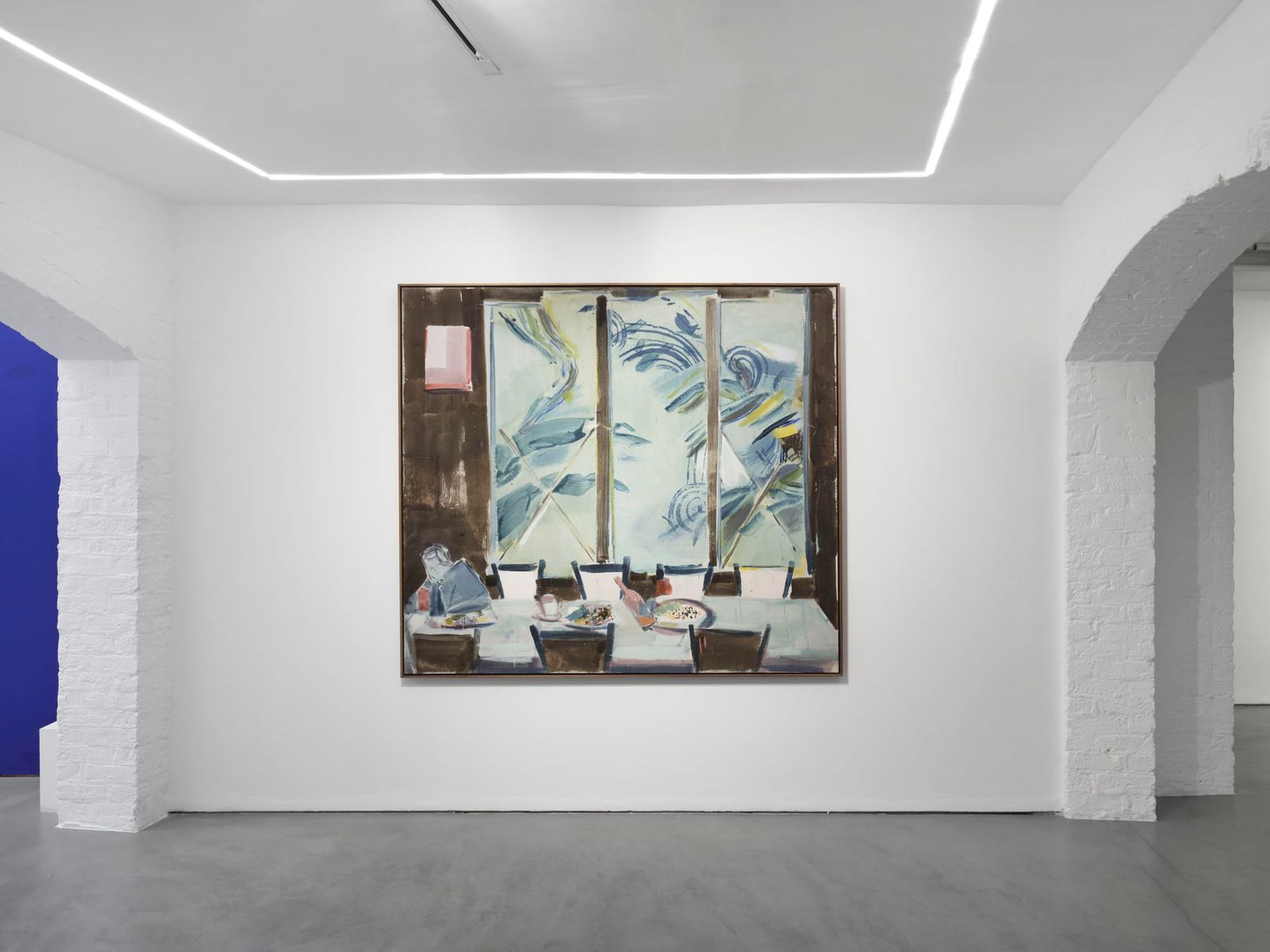
I’ve come to this island, not quite nine acres in total and situated in an affluent, westerly stretch of river, because it is currently the subject of a painting exhibition by an artist called Nick Goss – or, at least, a version of it is – and I want to find out more about the real thing. Goss’s show, currently on at Fitzrovia’s Josh Lilley Gallery, takes the fabled Eel Pie Hotel as its starting point. That is, the site of the commune which, before it fell to the long-hairs, had been both a glamorous Victorian leisure resort and a hip music venue where future stars of Swinging London cut their teeth.
A bend in the river by Nick Goss. (Image: Josh Lilley Gallery / Sutton Comms)
Anglo-Dutch painter Nick Goss habitually distorts a sense of place through his multi-disciplinary practice – oil washes layered with fragmented silk screen patterning lend a gauziness to otherwise recognisable landscapes or interiors. In this new exhibition, Eel Pie is warped by his brush, and rooted less in reality than in an imagined hybrid of all its incarnations throughout time. Across eleven paintings, the hotel is shown partially obscured by foliage from across the opposite towpath, or through its interior corridors where a blurred mass of revellers are whirling and jiving between numbered rooms. You’re never quite certain what version of hotel life you’re gazing at. Rendered in this manner, Nick’s island is enigmatic, inaccessible, unknowable. Considering that the hotel has long since disappeared, and that the island is totally under private ownership today, this is basically true.
Want to hear more of the city's hidden history and ignored stories? We take pride in going behind the scenes to get the real story, even if it takes weeks of work, so we can give this city some real, dedicated journalism. From months-long investigations to chaotic dispatches and untold stories of the capital’s history, we’ve got you covered.
We're grateful for whatever you can spare, but an annual subscription ensures allows our small team to produce even bigger and more ambitious stories. And as a gesture of thanks, if you take out a year’s membership of The Londoner, we’ll give you two months completely free. What's more, you'll get access to our entire back catalogue of members-only journalism, receive eight extra editions per month, and be able to come along to our fantastic members' events.
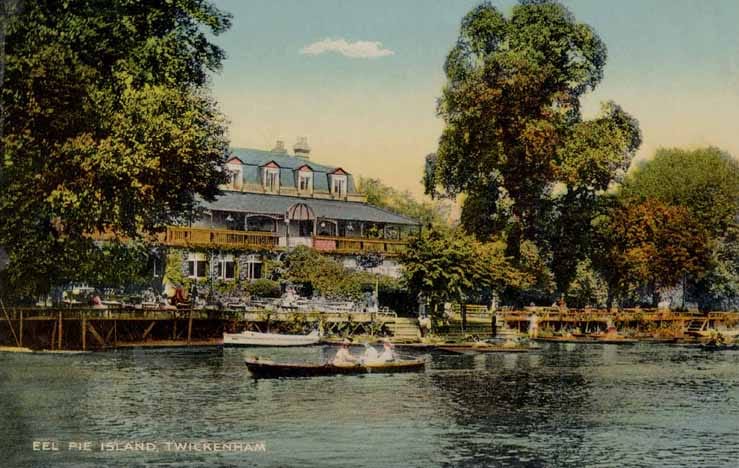
Now the stuff of legend, the Eel Pie Hotel was many things in its lifetime, but in every iteration there seems to have been dancing. Miss Morleena Kenwigs in Dickens’ Nicholas Nickleby (1839) heads “unto the Eel-pie Island at Twickenham” nine years after the hotel was first built, “to make merry upon a cold collation, bottled beer, shrub, and shrimps, and to dance in the open air to the music of a locomotive band”. Nineteenth-century illustrations and photographs of the hotel’s facade show a symmetrical building with jutting dormer windows and a pretty covered terrace on the second floor.
A postcard from 1900 of the Eel Pie Hotel in its prime (Image: Wikimedia Commons)
As the soundtrack changed from classical to jazz, the hotel remained a backdrop to dancing. The venue was to double down on its appeal as a dancing destination in 1951, when it was purchased by a Kingston shop owner called Michael Snapper, who, along with his savvy business partner Arthur Chisnall, recognised the potential of a three-floor riverside building with a ready-made sprung dancefloor to become a uniquely positioned music venue. In doing so, he cleverly pre-empted the desires of the emerging teenager class. More common in athletic or dance venues, the sprung floor provided a bounce that made concert-viewing all the more dynamic.
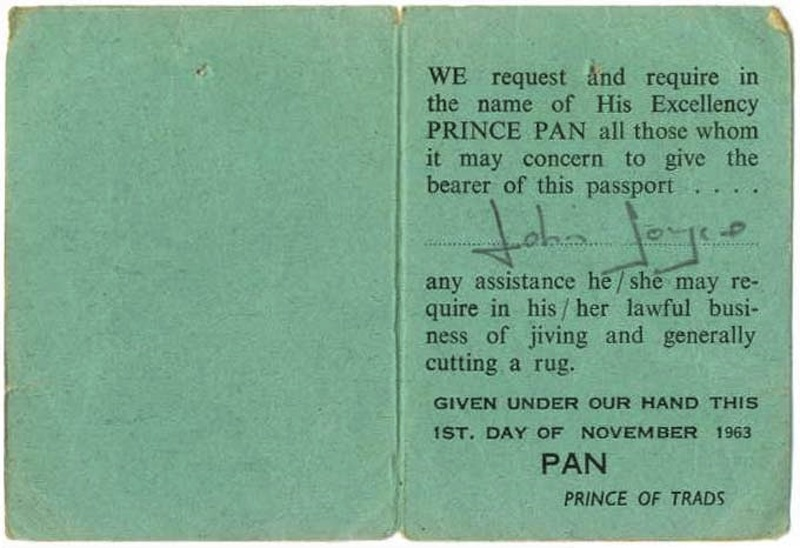
It was Snapper who commissioned the bridge in 1957, increasing footfall to an island that had previously only been accessible by barge. Regular visitors to the venue’s jazz and jive nights were rewarded with an EELPILAND passport for entry, whereas the more casual attendee had their arm stamped after paying their fee. Then came the 60s, the hotel’s musical hey-day. In a piece about the venue, The Guardianquotes Michele Whitby, the curator of the museum dedicated to Eel Pie Island, in describing the island as “all boatyards” and as having “very little residential accommodation”. And this was presumably just one reason why Eel Pie became such an important musical destination: the fans “thought the police would find it more difficult to come over and they were free to make more noise,” Whitby says.
The inside of an EELPILAND passport (Image via Messy Nessy)
The Rolling Stones were invited to take on a five-month residency at the venue, followed at various points by gigs from the likes of Cream, Pink Floyd, David Bowie, and The Who — but this era of the hotel functioning as a music venue soon came to an end. The building became a shadow of its Victorian self due to lack of investment as more money was spent on bookings than upkeep. The sprung dancefloor collapsed and the council revoked its licence in 1967. It seemed like the fun was over.
It might have been, if not for a shag-haired artist-cum-anarchist called Clifford, who came to the hotel with an easel and a dream. It was Cliff who Chris (“Canadian Chris”, as he signs his emails off) encountered on his journalistic quest, and who invited him to ditch the assignment and move on in, which he promptly did. According to Eel Pie Dharmathe other residents, who arrived in dribs and drabs, were a mix of “dossers, hippies, runaway schoolkids, drug dealers, petty thieves, heroin addicts, artists, poets, bikers, American hippie tourists, au pair girls, and Zen philosophers from all over the world”, with monikers like Fuckbucket Flo, Magic Mike and Gurdjieff Dave. Another resident, Weed, who lived in the hotel between January 1969 and August 1970, recalls the rag-tag community to me: “One of my favourite book titles is Beautiful Losers (Leonard Cohen, 1966) – of course, not all of us were beautiful, and not all of us were losers, but there were moments when some of us were lost in the beauty of it all. There are always those who search for meaning, especially in the transition from adolescence to adulthood, and that was probably as good a place as any to be while looking.”
Orgy rooms, weed and a mysterious inferno
Now approaching his 78th birthday, Chris’s recollections of the machinations of commune life are somewhat hazy (as a comment from Cliff on the former residents’ Facebook group puts it: “If you can remember it – then you weren’t there”), but he describes Cliff’s initial vision as akin to “an arts lab centre styled on existing arts labs in the UK,” referring to a counter-cultural movement of anti-establishment facilities for experimental artists. Shocked at the poverty that still existed in post-war London compared to the cosseted lives of his North-American peers, Chris wasn’t surprised when the bohemian vision fell apart at Eel Pie Hotel and it “quickly became more of a squat, a desperate home for the desperate disenfranchised”.
The hotel in its squatter era (Image via Messy Nessy)
That’s not to say that day-to-day life was without colour. In Eel Pie Dharma he describes how “most evenings we stayed up until the wee hours smoking incredibly strong three-paper joints of tobacco and hash and sucking on hash-stuffed chillums. Sometimes there were impromptu musical jams. Many could play, or attempted to play, guitar. We would all sing, until finally we lapsed into stoned reveries”. There was a designated orgy room, and the ballroom was given a makeover with “garish psychedelic paintings all over the flaking walls”. A photo on the Facebook group, posted by someone called Wavey Gravy, shows a tie-dyed teepee pitched up in the grounds where Miss Morleena had supped on her cold collation.
But without any proper infrastructure to sustain it, London’s answer to San Francisco’s Haight-Ashbury eventually became untenable. “The junkyard landlord had repeatedly tried to get us out, but to no avail. However, natural processes were destroying the commune both physically and spiritually. Floor boards had been ripped up [for fuel] for two winters, and the very foundations of the hotel had been weakened. Lead had been stripped off the roof and sold to metal dealers,” Chris writes. “While Eel Piers were slowly demolishing the building bit by bit, more and more wandering hippies, musicians, runaways and finally junkies and bikers moved in. Most of the original Eel Piers moved on to more secure squats in the heart of London [and] the bikers took to throwing stones through all the windows, and syringes could now be found littering the dirt-packed floors.” Chris left in 1970, and, after going back to Canada two years later, he’s only made one return visit to the UK since. The hotel – or what was left of it – burned down in 1971, while restoration work was already underway. The usual line is that it happened “under mysterious circumstances”.
Fast forward to 2026, I step off of the bridge onto terra firma and ask a fellow pedestrian if he knows which way the hotel had once been, and he obligingly points me down a footpath – which, it turns out, is the only such footpath on the island. There’s really only one direction you can walk before the path runs out and your way is blocked by the heavy red doors of the island’s boat building company, from behind which come the metallic scrapes and bangs of maritime industry. Looking again now on Google Maps, it seems that the path which bisects the islet doesn’t even cover the full length – in fact a sizeable portion of its north-east tip is hidden behind fences, concealed totally from prying eyes except for from the riverbanks of Ham and the fairy playground that is York House Gardens. It’s almost ridiculously charming, with its properties named things like Run Softly, Wild Thyme, and The Love Shack but it’s hard to shake the cynicism that comes with the knowledge that what was once the symbol of a free-spirited, hedonistic London youth quake is now prime real estate, off limits and enigmatic, just as Goss surmises through his art.
There's no signs of the hotel or its fascinating past on the island today (Image: India Brigitta Jarvis)
When I reach the path’s end I get chatting to Lis, a beautiful octogenarian, and resident of Eel Pie for some forty years, who shuffles toward me in Hoka trainers which she’s apparently test-driving, and a blue linen sunhat perched atop her white hair. A former singer, Lis lives in a house on the Aquarius complex, which popped up on top of the rubble of the hotel in the 1970s – a modernist affair of pale brick, “designed” as Lis puts it, “to maximise the river view”. Under normal circumstances the casual Eel Pie visitor would be unable to verify this, but Lis invites me in to see for myself what the atmosphere is like today.
Enjoying today's story? Please forward this email and help us spread the word about The Londoner.
The house is bright and airy, with spotless beige carpet and post-Impressionist style paintings. But it’s the garden, seen through huge windows, which Lis and I make a beeline for – the former swapping her blue linen hat for an identical one in baby-pink before we step out the back door. The lawn is tidy, punctuated by neat flower beds, and comes right to the water’s edge, where the view is of Ham’s leafy towpath and paddle boarders bobbing along the sleepy river. All traces of the site as a den of iniquity have been swept away. It’s hard to imagine someone pitching a teepee in this manicured paradise, but what strikes me most is the quiet – where Goss’s paintings and the hippie snapshots contain an almost palpable distant beat, in reality the music has well and truly stopped. There’s no escaping it. Social life on the island now is more about the yacht club’s start of season luncheon and community pot-luck suppers than racking lines with Mick Jagger. As Weed, who, unlike Chris, has returned to visit the area since 1970 tells me, “the beauty of the Island itself continues, but Twickenham is the poorer for the passing of the hotel and dancehall – they served as welcoming places for many generations”.
Can you spot the wine bottle we missed? (Image: Josh Lilley Gallery / Sutton Comms)
The next week, I return to Josh Lilley Gallery to take another look at Goss’s paintings. Their colour palette is tastefully muted, and they somehow achieve the near-impossible: capturing the marriage of present-day suburban domesticity with the haziness of memory the island evokes. I’m drawn to one canvas in particular: a lonely figure slumped at a long table, the suggestion of a lush garden seen through the windows behind him. The scene could be a sleek modern hotel conference room, or it could show a breakfast table in a comfortable family home, or – and now I register the single wine bottle in the picture – it could be someone in a drug-fuelled reverie seeing in the sunrise, the morning after the night before. Goss’s compositions feel particularly striking in how they capture Eel Pie Island through fragmentary glimpses rather than something more concrete. But they also serve as a reminder that memory and imagination are the only way to access a place like this, because – for better or for worse – Eel Pie Hotel and its delights could not exist today.
Nick Goss, Eel Pie Hotel,is on view till 23 May 2026 at Josh Lilley Gallery (40 – 46 Riding House Street London W1W 7EX).
This April, National Poetry Month Newsletter, The Banished Poets Society honours the power and passion of poetry to influence and impact the world with hope of transformation into peace and justice for every culture, every part of society.
We salute George Elliott Clarke for his dedication to promote black culture in poetry and music. We note with pride that the first black astronaut went on the moon voyage, accompanied by a skillful woman and an astronaut wearing the indigenous wisdom of the cosmos, insignia embroidered on his jacket, examples of the equality of all cultures, the wondrous aspects of humanity seeing the dark side of the moon for the first time. They showed us a radiant Earth, pure poetry in cosmic music.
This issue includes poetry from Italy, Israel, the U.S. many great Canadian poets and emerging poets from a variety of backgrounds who have found herein a platform to express past suppression, present hopes of healing and esteem.
All reflect on the beautiful vulnerable humanity we all share, our growing recognition of evil politics that threaten liberty and life for so many. Speaking out now against cruelty and injustice we save democracy, we help to transform the Earth into its glorious potential.
-Katherine L. Gordon. Editor. April, 2026
------------------------------------------------------------------------
Transcendence
We have seen the glowing Earth
from the dark side of the moon,
rare, beautiful, worthy of cherishing,
though its ancient dust no longer undisturbed
or home to quiet craters of possibility
but a frantic mix of bombs, bodies
poverty and fear
held hostage to the evil policies of tyrants.
Trump, Netanyahu, Putin, the evil trinity eclipsing democracy.
Yet the people are rising
from the mountains and valleys
the deserts and plains, the sea-shores, the forests,
discovering that voices joined can change the world.
This is the power of united human courage,
poetry and passion, the music of the cosmos
vibrating in waves that shape the future.
A new era of transcendence is born.
-Katherine L. Gordon
----------------------------------------------------------------------------
Gaza City
Across the water
across the bobbing,
yellow-striped fishing boats
in the long late light—
we see the gold of Gaza City,
sitting on the Mediterranean—
its sandstone minarets,
concrete apartment blocks,
Byzantine architecture.
And now more war is coming,
bringing with it the weapon
of enforced starvation.
Omar Mukhtar Street,
is soon to be blanketed
with the gray powder
of exploded and collapsed buildings.
Soon to be
like the rest of Gaza, where
we see tens of thousands
of the strewn dead,
of whom other thousands
are children. And
other thousands of children
are amputees—
maimed children
wander in the dust,
maimed children,
wandering
in the dust.
-Gene Grabiner
----------------------------------------------------------------------------
Shimmer and Slime
I have strolled down paths
aglow with marigold shimmer,
breathed in the tang of forever friends
who've wandered along with me...
side-stepped cracked
and broken culverts
skulking along the edges,
their scent of brackish water
as they seek their reflections at all costs.
Marigolds are not famously fragrant,
but their scent is one of honesty.
- B. Alexander
----------------------------------------------------------------------------
Washing Bananas
I want to tell you
how washing bananas is like
writing a poem
but the truth is
more complicated than that
I watch a woman
working in the factory noise
in Costa Rica
music blaring over loud speakers
roaring in the air
like midnight torture in a American prison
at Guantanamo Bay
and she moves the bone machine
of her body
dipping her arms
in the banana-floating water
that washes the yellow crop
with drippings of shipwrecked berries
in clutchable bunches
gripping each rinsed cluster
and lashing them one by one
into plastic baskets she pulls and shove
pulls and shoves
thereby filling her quota
she’s dressed in a rubber bib
running past her knees
her hands gloved to the elbow
a costermonger of the daily harvest
she’s a cog and wheel of the human spirit
paid by the dreary hour
of each dolorous day
the greengrocer’s serf and slave
-John B. Lee
------------------------------------------------------------------------
Dominion Day in Jail
(celebration 1975)
I spent last Dominion Day in jail
in a cold cell
on a steel bench -
cold, sleepless, angry and proud
tho almost wanting to feel foolish.
Fed a cheeseburger and a coffee in 24 hours
fingerprinted
stripped of my shirt
frogmarched - mugshot
insulted.
All this for the patriotic crime
of daring to say YANKEE GO HOME!
to the Yankee Shriners
parading thru downtown Toronto.
They thought it was the 4th of July
(Canada Division).
Cold, sleepless, hungry, angry
PROUD
that I was cold, sleepless, hungry, angry
and not enjoying the July sun
lounging on the green grass in Queen's Park
or lining the parade route for the Shriners.
This growing pride made my solitary jail cell
a celebration of Dominion Day.
-Chris Faiers
----------------------------------------------------------------------------
Grave Digger, or Not Another Ode
About the Trees
I’ve learned I’ve
pondered the trees
in a fallacious way.
Yes, I’m aware
the poets gorge
on oak & ash.
A sycamore is less.
Their buds outnumber
the sand.
But all this time their
branches have been
roots—roots have been
their scions—
stretching to a
sacrilege of light,
the undertow of earth.
This is why the
moles are nearly blind.
Treasure at the
bottom of abyss.
Squinting’s a game
for the quick
& not the dead.
Who decides what’s sky?
Behold the flight of worms.
Our grandson
stomps on leaves
to hear the crunching of
their bones. This is something
beauty cannot offer. Supple’s
invariably soundless—
which only the deaf can hear.
A surface
yet to wrinkle
hasn’t lived. To wither
is to feel the
sigh of God. There
below the stratum.
Every stone a star.
The basis for why
you’ll stop at six feet
down. Why you’ll roll
your beloved over
once the mourners
sob & flee. Her dreams had
always burrowed never
soared. Your shovel
like a staff
that splits the sea.
-Andreas Gripp
--------------------------------------------------------------------------
Rise Of The Hydra
We have been driven
deep into the heart of our yearning, . . .
— Robert Duncan
Another spring-tide is threatened by war —
war follows war as far back as memory lasts:
Korea, Vietnam, Afghanistan,
Iraq, and now Iran. Maybe Cuba’s next?
And still, human longing for peace persists.
Today, government thugs in black masks
beat and murder civilians, merely citizens
who only desire freedom from violence.
In this game there can be no winners;
we will all be losers, or even dead.
Six decades ago, Robert Duncan
saw the Hydra break loose destroying
bridges, temples, schools, rice fields,
entire villages — entire villages.
An ancient people faced the utter
destitution of years of war.
The young women and men who believed
they could stop the killing displayed
a raw courage and a truth that created
a green place within the blind earth,
a calm centre in the hurricane of fear.
And yet the United States has resumed
the slaughter of the innocents,
the reign of wrath.
How often will Herod return
to inhabit the White House?
School girls are hunted down in their classrooms,
deserts have been turned into mass graves.
As Ramadan and Lent fall together,
waves of bombers thunder overhead.
A whole region is laid waste.
How many times must the Hydra rise?
With each new war we are driven ever deeper
into the heart of our yearning, deeper
into our desperation for true brotherhood.
We seem to have been fighting the Death Cult
for generations, fighting the servants of evil
forever. The sky’s aflame over the Persian Gulf.
Outside, months of snow have been replaced by rain;
we hunger for the new life we pray spring will bring.
-James Deahl
-----------------------------------------------------------------------
Mother Wise
i
Soft earth opens like a woman.
Bulbs crown from her thighs
and bloom.
Fish swim from the river’s hips.
But Mama is so small
I am born of a wound.
ii
In a womb of time
the midwives lay
their hands on my twins’ damp heads.
They will bury the placenta
in the herb garden.
Its fine hairs will sprout
from the earth’s skin.
Excerpts from Good Grief
Shortlisted for the Next Generation Indie Book Awards
and the Global Book Awards - April Bulmer
----------------------------------------------------------------------------
War Effects
Child wanders in hunger
this is not what life should be
She looks to nearby adults
does not understand differences
Food must come from somewhere
plentiful on shelves, not UN Aid boxes
Enjoyment is not known to child
only suffering amidst war rubble
How dare nutrition is not available
even worse as a tool of ultimate power
Primary school should be for education
not as a missile or drone target
The word ‘War’ to stay in dictionaries
What happened to classmates and teachers
her playground to enjoy recess
Rubble and dust landscape
broken in wonderment
Friends spontaneously cry
over friends to never see again
Someday, when this is over
reunions will have somber moods
Adult recollections of this disaster
will forever need illness treatment
- Ed Woods
--------------------------------------------------------------------------
Lament for a HomelandAfter Edwin Muir
The anguish of plane engines in the night
heading to one of our never-ending wars
shatters our dreams; nightly we hear them roar,
rumble like thunder, fade
sound-smeared into the sky. Why? What has made
this land so plagued, its promise unfulfilled,
afraid of yet impatient for its doom,
unable to make room
enough between the river and the sea
for both to share? Must it forever be
all mine or only yours?
We were beguiled
like refugees returning to a lost isle
by the mirage of a land, that once was ours,
of milk and honey, eager to drink our fill;
we were betrayed
by decades of assumptions wrongly made
finding not sweetness there, but bitter gall,
the milk and honey turned to blood and dust;
considering ourselves just, we did not heed
the prophets warning us of future ills,
telling us milk will curdle, honey clot,
fruit slashed with swords will rot
our silos will be empty in time of need;
we, who through millennia never forgot
this land, imagined they,
its later conquerors, would fade away
quietly, or let us in without a fight.
While they believed
false prophets who urged them to savage deeds
for decades taught their children to hate, to kill
and do so still.
Extremists on both sides have sown this seed.
Beguiled by We are right,
betrayed by those who promised We will win,
no need to compromise,
ignoring even now the words of the wise,
both sides, lying awake in darkness, hear
over and over, these last hundred years
the anguish of plane engines in the night.
-Judy Koren
----------------------------------------------------------------------------
Green to Heal
Time does not pass
In this garden of citrus and thyme
With a sprinkling of dove
And sunbird
Where anemones thrive
And a blackbird praises Spring
And greens
The colour of calm and healing
Greens that ease
The pain of war…
-Helen Bar-Lev
--------------------------------------------------------------------------
For March 1
Oh, Love, we were bubbles
In the flotsam of time
Part of this river
Part of some rhyme
All promises fulfilled
All projects on hold
We had so many rivers
Before we grew old
The March wind was singing
Some wild hero’s song
The canoe was ready
The evenings grew long
And now we’re a couplet
In the epic of time
We followed our rivers
To the end of our rhyme
All dreams and all rivers
To the end of our rhyme
- Lenny Everson
--------------------------------------------------------------------------
APPEAL TO POETS
Poets, come out of your closets,
open your windows, open your doors,
you have been holed-up too long
in your closed worlds.
Lawrence Ferlinghetti - Populist Manifesto
Poets, let’s write words of Hope
for every country at war
where homes collapse,
like sandcastles at high tide,
where
an opaque veil
fills the air
and eyes are full of terror
where
children’s laughter
is too often silenced….
Poets, let’s spread words of Peace
on the far horizon
there is a promise,
waiting to bloom.
-Lidia Chiarelli
---------------------------------------------------------------------------
Gift of India
gift of india
gift of bones
gift of colour in the trees
silver round the ankles
glass around the wrist
dust in cloudy eyes, and
clouds, themselves, like
ash
i asked my eyes
they sang inward, nameless tunes
my ears rang dry
through all the drenching dazzling afternoons
i asked for nothing
but to crouch within
the crowds
the feet trampling
the dust below
the clouds above
the music of the anklets
set a ringing and a numbing
while the heat-dazed insects
stared
i asked no gift,
but it was given anyway
for the sound of the cicadas
for the smell of tamarind and tangy urine
for the incense toiling upward
for the small waxy flowers
with no voices
for the mindless march of feet
beating even in the rain
they have taken all my
numbers
and the letters of my
name
and given me these
inward eyes,
overcast and tuneless
like the eyes of the beggars
in the
lanes
-kymme sun
-------------------------------------------------------------------------
Transformation
Nature in eternal cycle, greens the Earth
rainbows her fields with flowers
buds fruit trees with promise of sustenance.
Poets transform war-burdened lands
with hope and forceful voices
visioning equality of justice, truth and sharing.
Speak your protests, embrace every culture,
all the dispossessed and weary.
Together we create transformation.
-Katherine L. Gordon
--------------------------------------------------------------------------
THE BANISHED POETS SOCIETY's Substack is free today. But if you enjoyed this post, you can tell THE BANISHED POETS SOCIETY's Substack that their writing is valuable by pledging a future subscription. You won't be charged unless they enable payments.
Today I received the following email from Judy Haiven, an old activist friend. She recently revisited Hari Kunzru's novel My Revolutions in a blog post, giving it high praise. Judy also reminded me that Hari Kunzru credits my memoir, Eel Pie Island Dharma, in the acknowledgments. Many thanks, Judy!
I remember a quote from Lit Hub by another author, also a lesser known writer like myself. Wish I'd kept the quote, but its essence was that there are great writers, who are like seas and large lakes, and then there are writers who may be but small streams, but our work helps feed these larger bodies of world literature.
Hari read the online account of my memoir which was posted in the early 2000s by weed, another Eel Pie Island communard. Weed's posting led to the professional publication of my memoir/haibun by Hidden Brook Press in 2012. Special thanks to Weed and to HBP publisher Tai Grove!
I must've talked to you about this extremely useful and good novel by the British novelist Harry kunzru strangely enough my son who now lives in London knows him because they're both writers I guess. in any case, this is a book that refers to your accounts of what happened in 69 and 70 and so on in London and I highly recommend it. I recommended it in my blog again this week. Judy Haiven
Hari Kunzru read an online posting of my 1990 memoir then titled Eel Pie Dharma. It was one of the earliest book length English language haibun. Many would follow in its footsteps, including myself, with a professional publication by Tai Grove with his Hidden Brook Press in 2012. Here's a pic from Amazon.
(from my 1969 haiku chapbook Cricket Formations - also in Foot Through the Ceiling, Aya Press, 1986 which received The Milton Acorn People's Poetry Award - and in many other publications)
Please note David McMurray selected a Honey Novick haiku below:
Neither heads nor tails sardines--all in the same boat --Tim Chamberlain (Tokyo)
* * *
first frost migrant boats turn away --Melissa Dennison (Bradford, England)
* * *
freezing fog an extra urgency in the blackbird’s call --Tony Williams (Glasgow, Scotland)
* * *
winter sparrows a Saint Francis statue streaked in white --A.J. Johnson (Stephens City, Virginia)
* * *
work, work, work-- a cat in the sun --Yoshiho Satake (Tokyo)
* * *
Snowdrift reaches the window a cat’s gaze --John J. Han (Manchester, Missouri)
* * *
Sleety night stray cats, too sit round the hearse --Yutaka Kitajima (Joetsu, Niigata)
* * *
Fear of the unknown... Gypsies driven from winter fields --Angela Giordano (Avigliano, Italy)
* * *
crunching salt beneath my feet… childhood fear --Artur Zielinski (Gdynia, Poland)
* * *
dreary winter rains sputter, muttering again no frosts --Mick McGann Jones (Kerry, Ireland)
------------------------------ FROM THE NOTEBOOK ------------------------------
faster, longer more work hours marathon olympic medal --June Read (Calgary, Alberta)
The Olympic Winter Games opened today, Feb. 6, in Milan and Cortina, Italy. Christina Chin traveled under the English Channel from Bournemouth, England to Genoa, Italy.
hopping onto the transcontinental train cold drafts
Ana Drobot felt invigorated. Ivan Georgiev opened a gate.
cold winter wind sharpening my senses
* * *
sense of home a stolen horse returning through the fog
David Greenwood forged ahead.
head tucked down the wind numbs all before it but my shadow
Pitt Buerken cheered for his favorite sports team until the very end of the game.
final whistle the team’s relegation is a done deal
Junko Saeki noted that her profession requires so much concentration, she disciplined herself to say “no, to all unexpected assignments after a full day of work,” adding that “it is not the most important thing in life.”
an interpreter I stumble out of the room after-hours meeting
In Perugia, Italy, Maria Tosti closed her eyes and dreamed of “skipping the calendar and going straight to March 21st!”
drawing still life--the last window light in the neighbourhood always mine
Laila Brahmbhatt watched a peaceful competition.
swans stretch their wings children measuring themselves in the water
Archie G. Carlos kept an eye on children playing in St. Louis Park, Minnesota. Writing from Taylorville, Illinois, Randy Brooks recalls how valleys with steep walls on three sides were used to corral wild horses America’s Wild West.
eight-foot snowbank the cul-de-sac kids’ growing interest
* * *
horse tracks in the snow to the box canyon none of them shoed
Morgan Ophir judged a diver in Sydney, Australia.
temple bell frog jumps a perfect circle
David Cox sat on his sofa watching “The Detectorists,” a quirky television show about lost treasure hunter-evaluators.
always a pen lid hoard under the middle cushion… antiqui-searcher
Feeling under the weather, Ella Aboutboul overheard equestrians chatting cheerfully as they passed by her window in West Sussex, England. Tsanka Shishkova was entertained by a virtuoso’s “Winter” in Sofia, Bulgaria.
winter melancholy clip-clopping riders laughing for me
* * *
snowstorm icy lace on the window Vivaldi’s violin
Tomislav Maretic wrote his resolutions for the incoming lunar new year in Zagreb, Croatia.
Chariots of fire-- I have not yet finished all my battles
Writing a tribute about a fashion icon in Tehran, Iran, Pegah Rahmati Nezhad closed with the words, “May she rest in beauty.”
in leap years i’m twenty-six Iris Apfel’s epilog
Alexander Groth contemplated the meaning of fleeting beauty in Berlin, Germany.
if beauty held not impermanence within what would be its worth
Mario Massimo Zontini looked over the fence from time to time in Parma, Italy.
another cold day my neighbour’s dog barks, not much
Chen-ou Liu pressed his nose up against a window in Ajax, Ontario. Georgiev kept his nose to the grindstone in Gottingen, Germany.
work work work and work etched across my office pane... sunlight tinged gray
* * *
backbreaking work closer and closer to the ground
Dennison noted on her calendar that the hardworking squirrels which concealed food with their snout and paws last autumn will soon awake from hibernation. Marie Derley tried to suspend time in Ath, Belgium. Urszula Marciniak awoke early in Lodz, Poland.
tap...tap...tap... a squirrel buries nuts
* * *
staying in autumn because the image is nicer wall calendar
* * *
a winter morning a squirrel clutching a dug-up nut
Haikuists celebrated end of winter (setsubun) events by throwing beans to ward off evil spirits at shrines and temples. Attending the Feb. 3 festival at a temple in Tokyo, Murasaki Sagano felt like a kid again. At home in his kitchen in Honolulu, Hawaii, Raj K. Bose fondly recalled playing with his brothers and sisters.
waffle hollows full of honey… bean-throwing festival
* * *
shelling peas I recall the faces of all my siblings
Teiichi Suzuki sat near sumo wrestlers in the subway who were heading home from Nanba station in Osaka.
Sweet scented hair oil from sumo wrestlers’ topknots the crowded subway
Robin Rich threw a peanut to feed a squirrel but a crow got the rebound in icy Brighton, England.
throwing crows the monkey nuts… bounce off puddles
In Draguignan, France, Francoise Maurice watched flat stones skip across the ice.
frozen pond--anyway he throws a stone
Honey Novick tossed a coin for good luck in Toronto, Ontario.
winds of change breathe hope like a wishing well dragon new year new dreams abound
Dennison shivered at the sound of chemical reactions.
throwing salt... the hiss and crackle of ice
Carlos cried in St. Louis Park, Minnesota.
ice pellets the sting of tear gas
Scott Reid froze in Monte Rio, California.
Minnesota ice-- the frozen song of poetry
Rob Scott created this line fissure in Melbourne, Australia.
cracking ice another deadline approaches
Anthony Q. Rabang risked seven years of bad luck in Santa Catalina, Philippines.
swinging and slashing with plastic swords cracks on the mirror
Worried that “spirits wander aimlessly in suspended time,” Giordano shut her door tight at the seasonal division of winter and spring.
closed doors--devils and witches rule the night
Asleep at home in Nienhagen, Germany, Isabella Kramer’s eyes suddenly opened wide in the dark.
hidden moon the something under my pillow moves
Maretic recounted the history of the horses that were set free to roam in a wilderness region of Bosnia and Herzegovina, rather than be sent to slaughter.
rusty plows-- our horses take care of themselves
* * *
snowy landscape-- Livno wild horses lick the salt from the road
Slobodan Pupovac outstretched a handful of salt on a farm in Zagreb, Croatia. Georgiev watched a similar scene. Pegah Rahmati Nezhad relaxed in Tehran, Iran.
happy cow moist palm of my right hand
* * *
temptation the salt already dissolved in his warm hand
* * *
in her palm a volcano hummingbird in torpor
Sagano received a packet of salt to carry home.
purified salt after the funeral winter solitude
Patrick Sweeney empathized with a Russian author who helped to raise global awareness of political repression in the Soviet Union and the Gulag prison system.
house to the car with cane I’m Solzhenitsyn in the snow
Yutaka Kitajima turned up the heat in Joetsu, Niigata Prefecture.
The coal stove maxes... a soporific lecture on The Tale of Genji
Dejan Ivanovic looks forward to Feb. 14 Valentine’s Day celebrations of love in Lazarevac, Serbia. Luciana Moretto pitied poor Juliet Capulet’s popularity with tourists in Treviso, Italy.
frosty February the cats already meow that love is in the air
* * *
Juliet’s statue in Verona her right breast worn out... endless yearning
Jackie Chou read a love story in Pico Rivera, California.
old diary his name and mine locked in a heart
Sagano visited India.
Taj Mahal love crosswords in marble windy flowers
Feeling melancholic from a profound saudade, Foteini Georgakopoulou found refuge in Athens, Greece.
in the shade of a past love I shelter in the winter
Sagano was charmed at a classical style cafe in Tokyo by an aged waiter who warned “please, be careful.”
hot wet towel placed unfolded on my hands Valentine’s Day waiter
Visiting Medellin, Colombia, Dina Towbin implored her lunch companions to share their leftovers rather than let the waitstaff return the exquisite-tasting food and beverages to the kitchen.
unforgettable lemonade delicious cheesy bread don’t let them take yours
Kitajima dedicated this poem to his granddaughter, who is “charming like Kaguya-hime.” In a folktale about a bamboo cutter, a mysterious baby found in a bamboo stalk grew into a beautiful woman who rejected all her suitors with impossible tasks until she flew away to the moon.
Puffy wind stirs fluffy hairs off the bonnet
Lethargic after a vacation away from his political science studies at St. Xavier’s College in Kolkata, India, Allen David Simon felt a little off routine.
year’s first class-- my fingers forgot how to hold a pen
Yumi Miyashita won the 7th Annual English Haiku Contest at Kagawa University. Judges praised the work of the fifth-year medical student for sharing a real story in a “vivid, powerful, and memorable haiku” which strikes at all our senses.
Blood pumping from the bag Like drums calling out her name She is meant to live
Zontini heard mellow, mournful sounds at a beach. Gordana Vlasic wondered if birds might have escaped from a zoo. The cold seeped deep into Johnson’s thoughts. Vasile Moldovan observed birds form Vs as they migrated further south from Bucharest, Romania.
the snow falls: from the shore the muffled cry of the plovers
* * *
frozen lake-- at the zoo the children search for swans
* * *
not far enough south tundra swans honk at freezing rain
* * *
the northern wind increasing their flying speed flocks of cranes
The next issue of the Asahi Haikuist Network appears Feb. 20. Readers are invited to send haiku about imperfection on a postcard to David McMurray at the International University of Kagoshima, Sakanoue 8-34-1, Kagoshima, 891-0197, Japan, or e-mail to mcmurray@fka.att.ne.jp.
* * *
David McMurray
David McMurray has been writing the Asahi Haikuist Network column since April 1995, first for the Asahi Evening News. He is on the editorial board of the Red Moon Anthology of English-Language Haiku, columnist for the Haiku International Association, and is editor of Teaching Assistance, a column in The Language Teacher of the Japan Association for Language Teaching (JALT).
McMurray is professor of intercultural studies at The International University of Kagoshima where he lectures on international haiku. At the Graduate School he supervises students who research haiku. He is a correspondent school teacher of Haiku in English for the Asahi Culture Center in Tokyo.
McMurray judges haiku contests organized by The International University of Kagoshima, Ito En Oi Ocha, Asahi Culture Center, Matsuyama City, Polish Haiku Association, Ministry of Foreign Affairs, Seinan Jo Gakuin University, and Only One Tree.
McMurray’s award-winning books include: “Teaching and Learning Haiku in English” (2022); “Only One Tree Haiku, Music & Metaphor” (2015); “Canada Project Collected Essays & Poems” Vols. 1-8 (2013); and “Haiku in English as a Japanese Language” (2003).