Our Saturday stories are free for all to read — but we can only survive with your help (and we're currently being sued for £250,000 by a wealthy Airbnb grifter). If you're a fan of today's piece, please do consider becoming a paying member. And with our spring discount, it costs less than a fiver a month (for your first three months) to support us. | |
|
In the late 1960s, Chris Faiers was down and out in London. Canadian by birth, he’d grown up in North America and emigrated, like so many other young men, to dodge the Vietnam draft, after having received three notices in a week. When he walked into the offices of a local newspaper in Richmond to ask for a job, he was surprised when he was taken seriously – the editor gave him a test assignment, telling him about some hippies who had started a commune in an abandoned hotel in Twickenham. The hotel was on a little island in the middle of the Thames. He caught the bus to Twickenham and found the footbridge which led to the island. “It was about two hundred feet across the little bridge, with a beautiful view of the Thames,” he writes in his haiku-laden, LSD-infused memoir, Eel Pie Dharma. “When I had reached the island I felt I had entered a special place. A footpath lined with neat little cottages wound through the centre of the island. There was no missing the old hotel at the end of the footpath. It was derelict, and I just walked in where the grand front entrance had once been.” Faiers is right about the view. There’s something almost Scandinavian about it, from where Eel Pie Island connects to the Thames embankment at Twickenham via a humped iron bridge: thickets of dense greenery dapple the light over little corrugated iron houses, converted from boat stores, which hug the water’s edge. Some dwellings have their own jetties, all have pleasant garden seating areas and are a picture of idyllic outdoor living. I’ve come to this island, not quite nine acres in total and situated in an affluent, westerly stretch of river, because it is currently the subject of a painting exhibition by an artist called Nick Goss – or, at least, a version of it is – and I want to find out more about the real thing. Goss’s show, currently on at Fitzrovia’s Josh Lilley Gallery, takes the fabled Eel Pie Hotel as its starting point. That is, the site of the commune which, before it fell to the long-hairs, had been both a glamorous Victorian leisure resort and a hip music venue where future stars of Swinging London cut their teeth. 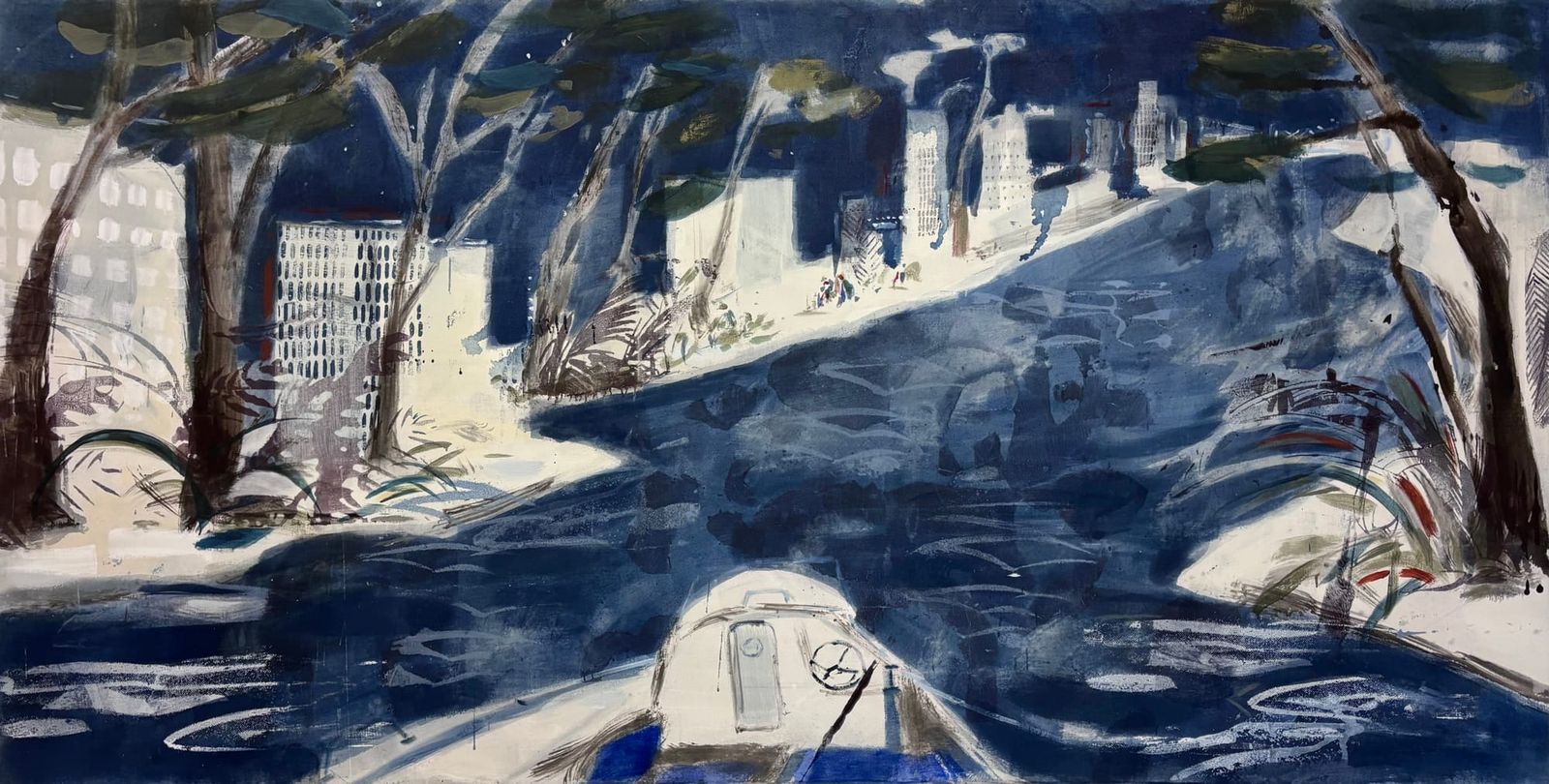 A bend in the river by Nick Goss. (Image: Josh Lilley Gallery / Sutton Comms) Anglo-Dutch painter Nick Goss habitually distorts a sense of place through his multi-disciplinary practice – oil washes layered with fragmented silk screen patterning lend a gauziness to otherwise recognisable landscapes or interiors. In this new exhibition, Eel Pie is warped by his brush, and rooted less in reality than in an imagined hybrid of all its incarnations throughout time. Across eleven paintings, the hotel is shown partially obscured by foliage from across the opposite towpath, or through its interior corridors where a blurred mass of revellers are whirling and jiving between numbered rooms. You’re never quite certain what version of hotel life you’re gazing at. Rendered in this manner, Nick’s island is enigmatic, inaccessible, unknowable. Considering that the hotel has long since disappeared, and that the island is totally under private ownership today, this is basically true. Want to hear more of the city's hidden history and ignored stories? We take pride in going behind the scenes to get the real story, even if it takes weeks of work, so we can give this city some real, dedicated journalism. From months-long investigations to chaotic dispatches and untold stories of the capital’s history, we’ve got you covered. We're grateful for whatever you can spare, but an annual subscription ensures allows our small team to produce even bigger and more ambitious stories. And as a gesture of thanks, if you take out a year’s membership of The Londoner, we’ll give you two months completely free. What's more, you'll get access to our entire back catalogue of members-only journalism, receive eight extra editions per month, and be able to come along to our fantastic members' events. | |
|
|
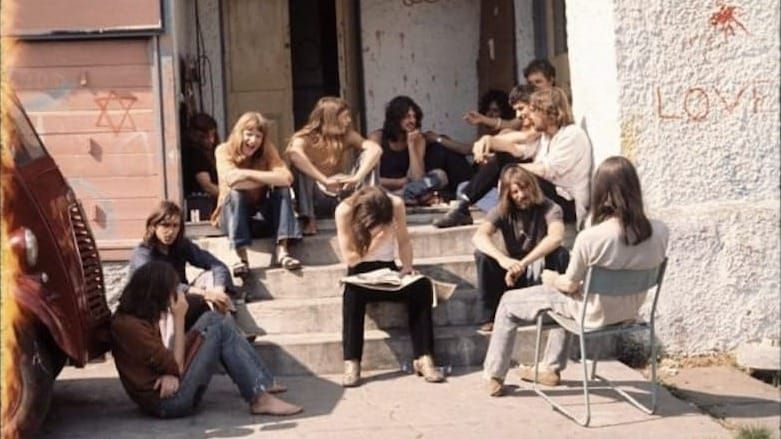
Welcome to Eel Pie IslandNow the stuff of legend, the Eel Pie Hotel was many things in its lifetime, but in every iteration there seems to have been dancing. Miss Morleena Kenwigs in Dickens’ Nicholas Nickleby (1839) heads “unto the Eel-pie Island at Twickenham” nine years after the hotel was first built, “to make merry upon a cold collation, bottled beer, shrub, and shrimps, and to dance in the open air to the music of a locomotive band”. Nineteenth-century illustrations and photographs of the hotel’s facade show a symmetrical building with jutting dormer windows and a pretty covered terrace on the second floor. 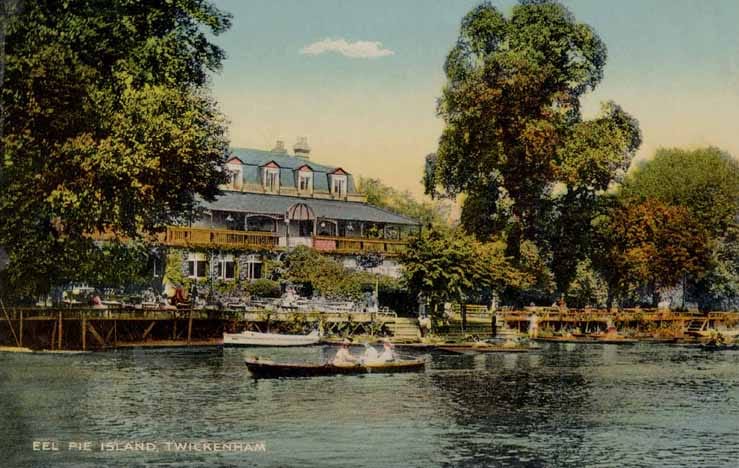 A postcard from 1900 of the Eel Pie Hotel in its prime (Image: Wikimedia Commons) As the soundtrack changed from classical to jazz, the hotel remained a backdrop to dancing. The venue was to double down on its appeal as a dancing destination in 1951, when it was purchased by a Kingston shop owner called Michael Snapper, who, along with his savvy business partner Arthur Chisnall, recognised the potential of a three-floor riverside building with a ready-made sprung dancefloor to become a uniquely positioned music venue. In doing so, he cleverly pre-empted the desires of the emerging teenager class. More common in athletic or dance venues, the sprung floor provided a bounce that made concert-viewing all the more dynamic. It was Snapper who commissioned the bridge in 1957, increasing footfall to an island that had previously only been accessible by barge. Regular visitors to the venue’s jazz and jive nights were rewarded with an EELPILAND passport for entry, whereas the more casual attendee had their arm stamped after paying their fee. Then came the 60s, the hotel’s musical hey-day. In a piece about the venue, The Guardianquotes Michele Whitby, the curator of the museum dedicated to Eel Pie Island, in describing the island as “all boatyards” and as having “very little residential accommodation”. And this was presumably just one reason why Eel Pie became such an important musical destination: the fans “thought the police would find it more difficult to come over and they were free to make more noise,” Whitby says. 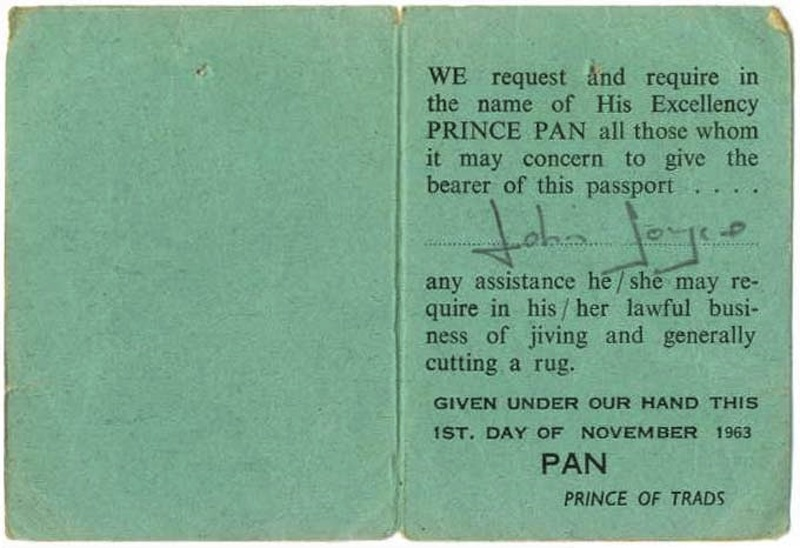 The inside of an EELPILAND passport (Image via Messy Nessy) The Rolling Stones were invited to take on a five-month residency at the venue, followed at various points by gigs from the likes of Cream, Pink Floyd, David Bowie, and The Who — but this era of the hotel functioning as a music venue soon came to an end. The building became a shadow of its Victorian self due to lack of investment as more money was spent on bookings than upkeep. The sprung dancefloor collapsed and the council revoked its licence in 1967. It seemed like the fun was over. It might have been, if not for a shag-haired artist-cum-anarchist called Clifford, who came to the hotel with an easel and a dream. It was Cliff who Chris (“Canadian Chris”, as he signs his emails off) encountered on his journalistic quest, and who invited him to ditch the assignment and move on in, which he promptly did. According to Eel Pie Dharmathe other residents, who arrived in dribs and drabs, were a mix of “dossers, hippies, runaway schoolkids, drug dealers, petty thieves, heroin addicts, artists, poets, bikers, American hippie tourists, au pair girls, and Zen philosophers from all over the world”, with monikers like Fuckbucket Flo, Magic Mike and Gurdjieff Dave. Another resident, Weed, who lived in the hotel between January 1969 and August 1970, recalls the rag-tag community to me: “One of my favourite book titles is Beautiful Losers (Leonard Cohen, 1966) – of course, not all of us were beautiful, and not all of us were losers, but there were moments when some of us were lost in the beauty of it all. There are always those who search for meaning, especially in the transition from adolescence to adulthood, and that was probably as good a place as any to be while looking.” Orgy rooms, weed and a mysterious infernoNow approaching his 78th birthday, Chris’s recollections of the machinations of commune life are somewhat hazy (as a comment from Cliff on the former residents’ Facebook group puts it: “If you can remember it – then you weren’t there”), but he describes Cliff’s initial vision as akin to “an arts lab centre styled on existing arts labs in the UK,” referring to a counter-cultural movement of anti-establishment facilities for experimental artists. Shocked at the poverty that still existed in post-war London compared to the cosseted lives of his North-American peers, Chris wasn’t surprised when the bohemian vision fell apart at Eel Pie Hotel and it “quickly became more of a squat, a desperate home for the desperate disenfranchised”. 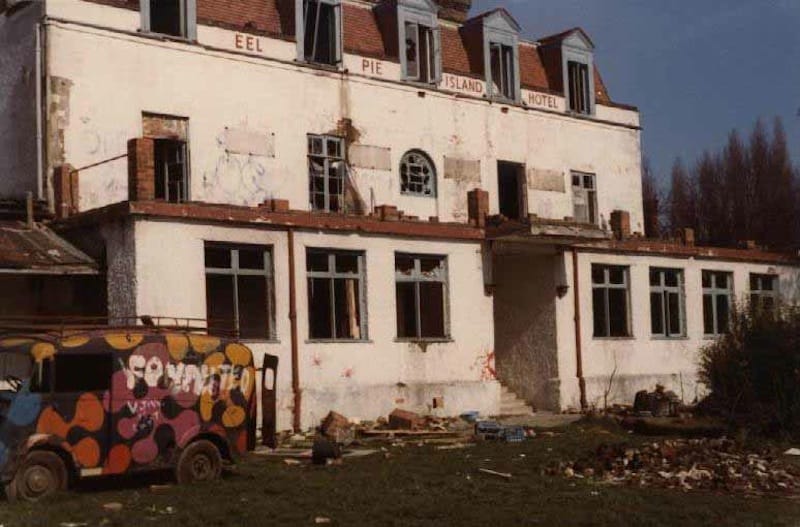 The hotel in its squatter era (Image via Messy Nessy) That’s not to say that day-to-day life was without colour. In Eel Pie Dharma he describes how “most evenings we stayed up until the wee hours smoking incredibly strong three-paper joints of tobacco and hash and sucking on hash-stuffed chillums. Sometimes there were impromptu musical jams. Many could play, or attempted to play, guitar. We would all sing, until finally we lapsed into stoned reveries”. There was a designated orgy room, and the ballroom was given a makeover with “garish psychedelic paintings all over the flaking walls”. A photo on the Facebook group, posted by someone called Wavey Gravy, shows a tie-dyed teepee pitched up in the grounds where Miss Morleena had supped on her cold collation. But without any proper infrastructure to sustain it, London’s answer to San Francisco’s Haight-Ashbury eventually became untenable. “The junkyard landlord had repeatedly tried to get us out, but to no avail. However, natural processes were destroying the commune both physically and spiritually. Floor boards had been ripped up [for fuel] for two winters, and the very foundations of the hotel had been weakened. Lead had been stripped off the roof and sold to metal dealers,” Chris writes. “While Eel Piers were slowly demolishing the building bit by bit, more and more wandering hippies, musicians, runaways and finally junkies and bikers moved in. Most of the original Eel Piers moved on to more secure squats in the heart of London [and] the bikers took to throwing stones through all the windows, and syringes could now be found littering the dirt-packed floors.” Chris left in 1970, and, after going back to Canada two years later, he’s only made one return visit to the UK since. The hotel – or what was left of it – burned down in 1971, while restoration work was already underway. The usual line is that it happened “under mysterious circumstances”. Fast forward to 2026, I step off of the bridge onto terra firma and ask a fellow pedestrian if he knows which way the hotel had once been, and he obligingly points me down a footpath – which, it turns out, is the only such footpath on the island. There’s really only one direction you can walk before the path runs out and your way is blocked by the heavy red doors of the island’s boat building company, from behind which come the metallic scrapes and bangs of maritime industry. Looking again now on Google Maps, it seems that the path which bisects the islet doesn’t even cover the full length – in fact a sizeable portion of its north-east tip is hidden behind fences, concealed totally from prying eyes except for from the riverbanks of Ham and the fairy playground that is York House Gardens. It’s almost ridiculously charming, with its properties named things like Run Softly, Wild Thyme, and The Love Shack but it’s hard to shake the cynicism that comes with the knowledge that what was once the symbol of a free-spirited, hedonistic London youth quake is now prime real estate, off limits and enigmatic, just as Goss surmises through his art. 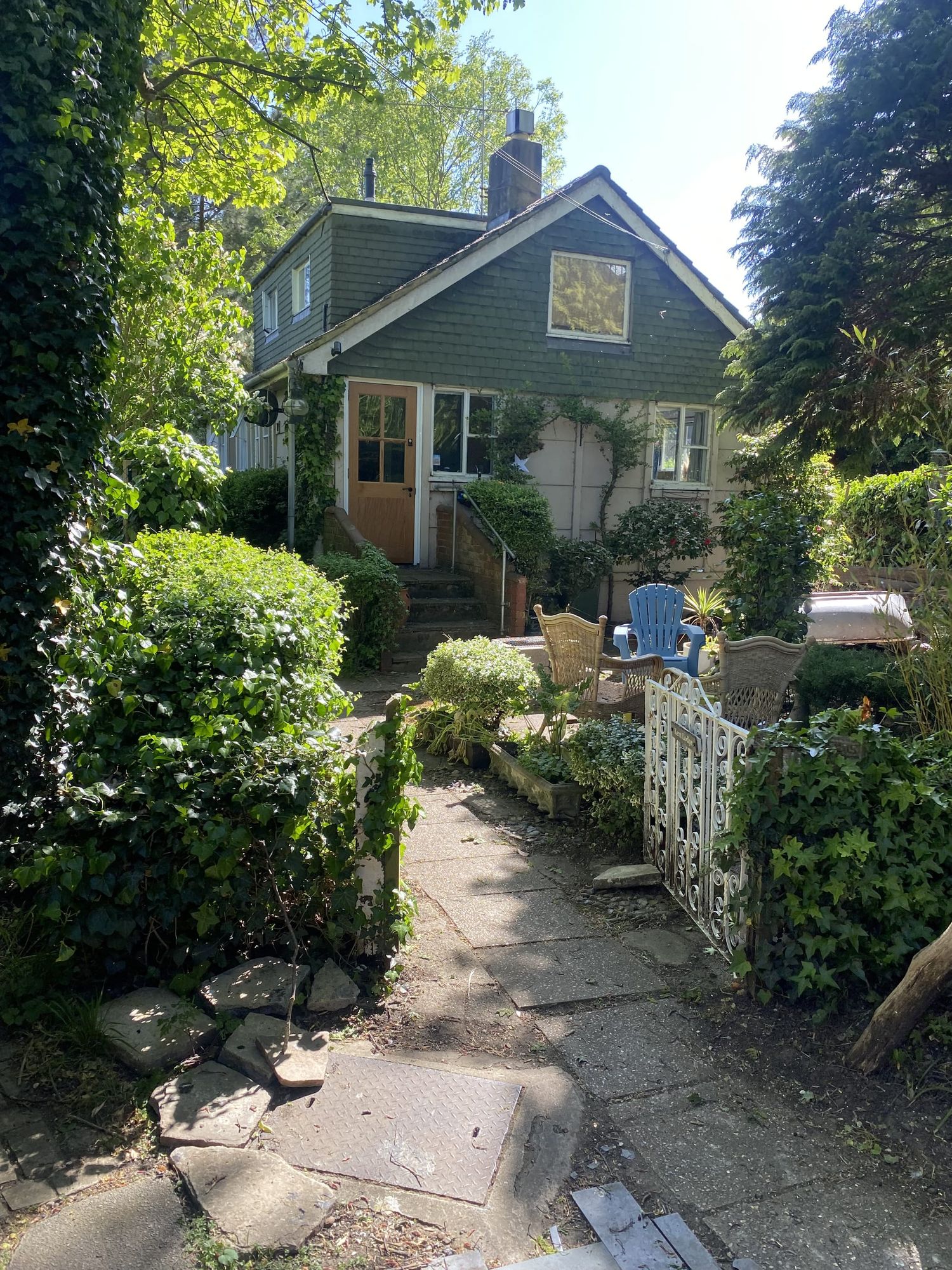 There's no signs of the hotel or its fascinating past on the island today (Image: India Brigitta Jarvis) When I reach the path’s end I get chatting to Lis, a beautiful octogenarian, and resident of Eel Pie for some forty years, who shuffles toward me in Hoka trainers which she’s apparently test-driving, and a blue linen sunhat perched atop her white hair. A former singer, Lis lives in a house on the Aquarius complex, which popped up on top of the rubble of the hotel in the 1970s – a modernist affair of pale brick, “designed” as Lis puts it, “to maximise the river view”. Under normal circumstances the casual Eel Pie visitor would be unable to verify this, but Lis invites me in to see for myself what the atmosphere is like today. Enjoying today's story? Please forward this email and help us spread the word about The Londoner. |
|
The house is bright and airy, with spotless beige carpet and post-Impressionist style paintings. But it’s the garden, seen through huge windows, which Lis and I make a beeline for – the former swapping her blue linen hat for an identical one in baby-pink before we step out the back door. The lawn is tidy, punctuated by neat flower beds, and comes right to the water’s edge, where the view is of Ham’s leafy towpath and paddle boarders bobbing along the sleepy river. All traces of the site as a den of iniquity have been swept away. It’s hard to imagine someone pitching a teepee in this manicured paradise, but what strikes me most is the quiet – where Goss’s paintings and the hippie snapshots contain an almost palpable distant beat, in reality the music has well and truly stopped. There’s no escaping it. Social life on the island now is more about the yacht club’s start of season luncheon and community pot-luck suppers than racking lines with Mick Jagger. As Weed, who, unlike Chris, has returned to visit the area since 1970 tells me, “the beauty of the Island itself continues, but Twickenham is the poorer for the passing of the hotel and dancehall – they served as welcoming places for many generations”. 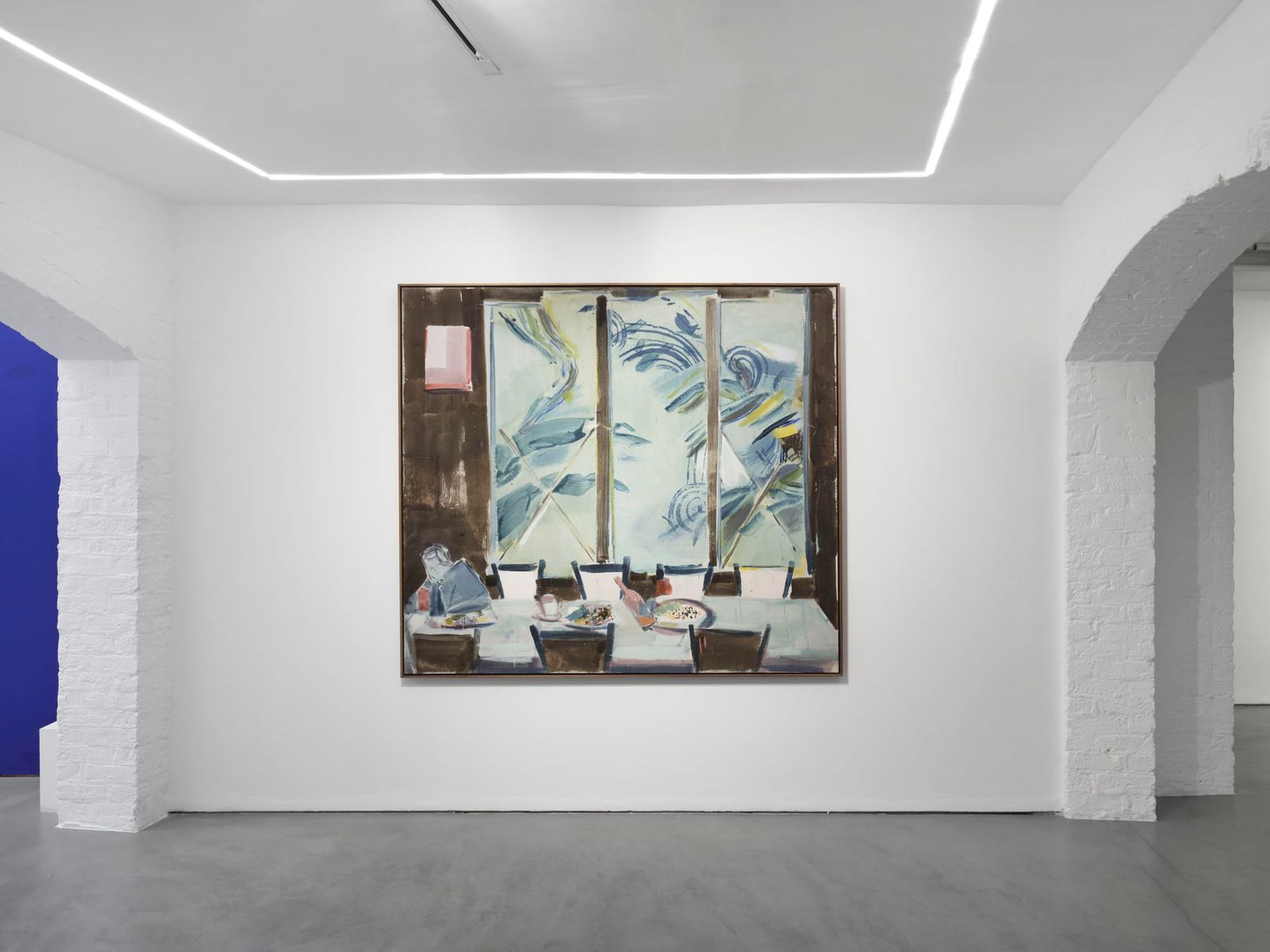 Can you spot the wine bottle we missed? (Image: Josh Lilley Gallery / Sutton Comms) The next week, I return to Josh Lilley Gallery to take another look at Goss’s paintings. Their colour palette is tastefully muted, and they somehow achieve the near-impossible: capturing the marriage of present-day suburban domesticity with the haziness of memory the island evokes. I’m drawn to one canvas in particular: a lonely figure slumped at a long table, the suggestion of a lush garden seen through the windows behind him. The scene could be a sleek modern hotel conference room, or it could show a breakfast table in a comfortable family home, or – and now I register the single wine bottle in the picture – it could be someone in a drug-fuelled reverie seeing in the sunrise, the morning after the night before. Goss’s compositions feel particularly striking in how they capture Eel Pie Island through fragmentary glimpses rather than something more concrete. But they also serve as a reminder that memory and imagination are the only way to access a place like this, because – for better or for worse – Eel Pie Hotel and its delights could not exist today. Nick Goss, Eel Pie Hotel, is on view till 23 May 2026 at Josh Lilley Gallery (40 – 46 Riding House Street London W1W 7EX). |



No comments:
Post a Comment