Total Pageviews

Showing posts with label About Retirement newsletter. Show all posts

Sunday, 26 October 2025

Living with Anxiety in the Digital Age: Joyce Wayne (from her newsletter About Retirement)


Living with Anxiety in the Digital Age

By Joyce Wayne

Recent worldwide events have created an atmosphere of unease for many of us. If you’re a baby boomer, you’ve already lived through more than your fair share of history’s turbulence: the Vietnam War, Watergate, the Iranian hostage crisis, the end of the Cold War, 9/11, and the 2008 market crash. Since 2020, we’ve endured the COVID-19 pandemic while watching the Russian invasion of Ukraine and, most recently, the war in Gaza. It feels as though the shocks arrive faster and cut deeper with every decade.

How Does Technology Cause Anxiety?

At the same time, our daily habits have shifted in ways that feed this constant sense of tension. Many of us have grown accustomed to spending a large portion of our days online. My relationship with technology, for example, has changed from casual acquaintance to constant companion. In 2000, there was one desktop computer in the basement rec room. I had a Blackberry that I used conscientiously, almost cautiously, with a sense of self-control.

Fast forward to today, and my iPhone seems to run my life rather than the other way around. Hours slip away as I scroll, read, and delete emails. “It’s necessary,” I tell myself, “What if I miss something important?” With the ongoing, intermittent mail strike, the phone feels even more essential—what if a bill doesn’t arrive, or a payment is overlooked? The “what ifs” pile up quickly, each one pulling me deeper into my screen.

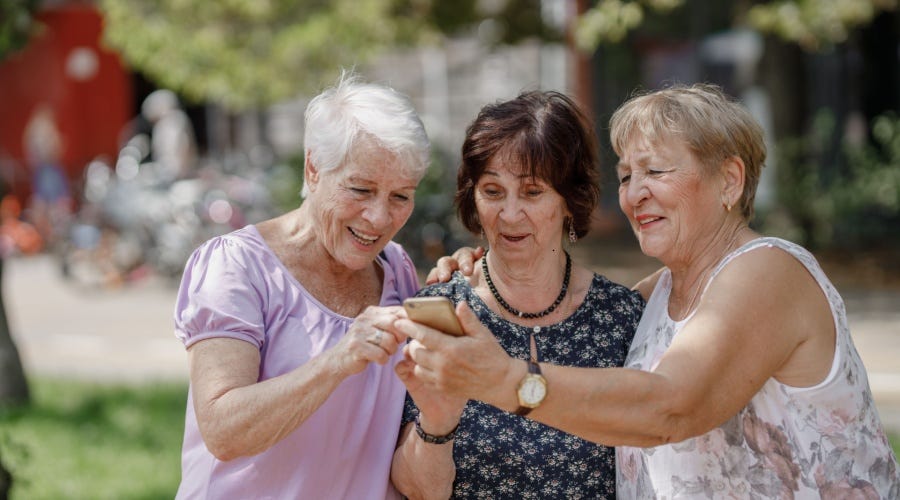
Yesterday, while having a manicure, I noticed something that made me pause. Every woman in the salon—myself included—was absorbed in her phone. A group of older women, side by side, eyes fixed on glowing screens. The room was hushed, except for the occasional ringtone and the rhythmic tapping of screens. It struck me how easily we surrender human connection to the convenience of our devices. Conversation, laughter, the simple pleasure of being together and enjoying the manicure—all replaced by the hypnotic pull of the phone.

This 21st-century phenomenon explains why Arthur Brooks’ essay in The Atlantic resonated with me so strongly. Brooks writes:

Anxiety disorders are the most common mental illnesses in America today, affecting more than 40 million adults at any given time (and far more women than men). According to the American Psychological Association, the average American teenager spends nearly five hours a day on these platforms. As scholars in 2017 showed, the risk of anxiety as a disorder rises with the amount of time a person spends on social media. This risk factor was exacerbated during the pandemic lockdowns, likely by loneliness, money worries, reduced physical activity, and domestic strife.”

Managing Digital Anxiety: Turning Anxiety into Motivation and Growth

Brooks’ point is that while technology has amplified our anxieties, anxiety itself is not necessarily the villain we believe it to be. “The secret,” he suggests, “is to turn your feeling of dread into the excitement of opportunity. Within healthy boundaries and when properly managed, anxiety is an integral part of life that can afford learning, raise performance, and even make life an adventure.”

For Brooks, anxiety is less a disorder than an alarm system. Evolutionary biologists echo this: anxiety is not a glitch but a protective mechanism, designed to alert us to hazards before they become dangerous. When seen this way, anxiety becomes less about fear and more about energy we can harness.

I recognize this in my own life. Although I’ve long considered myself an anxious person, I also know that anxiety has often propelled me forward. It’s what gets me moving when a project feels daunting. It’s what pushes me to finish a hard task rather than giving up halfway through.

Everyday Solutions for Channeling Anxiety Into Progress

Take writing, for instance. Beginning a new novel is always terrifying. I never know where the story will go, how the characters will develop, or even how the book will end. In those early days, anxiety feeds me a steady stream of excuses: I’m too old, the project is too big, it would be easier not to begin. Yet that very fear becomes fuel. It drives me past hesitation into the blank page, where creativity—and sometimes magic—happens.

And it’s not only in writing. Everyday life offers plenty of moments where anxiety nudges us forward: driving on a crowded highway, waiting for medical results, taking out a loan, or even daring to travel somewhere new. Each situation brings its “what ifs.” What if the driver next to me causes an accident? What if the test reveals something serious? What if I can’t repay the loan? If we let those questions paralyze us, our lives would be small, uneventful, and joyless. By facing anxiety, we open the door to connection, accomplishment, and meaning.

Building a Healthier Relationship with Anxiety as We Age

This, I’ve come to believe, is the paradox of aging. With time comes not less anxiety, but perhaps a wiser relationship to it. We learn that it won’t vanish, but it can be managed. We discover that fear doesn’t always signal danger—it often signals growth. And, if we let it, anxiety can sharpen our focus and remind us that life’s most meaningful pursuits often come wrapped in uncertainty.

As I grow older, I find I’m getting better at leaning into that truth. It’s easier to let go, to try new things, to aim high. It’s also easier to recognize when the endless scrolling and searching on the web is just a distraction from what really matters.

So, perhaps the lesson is this: take the chance, even if it stirs some anxiety. Step into the unknown, even if it makes your heart race. More often than not, it’s worth the trouble. And in those moments when anxiety threatens to overwhelm, remind yourself that it is also your alarm system—your body’s way of saying, “Pay attention. This matters.”
Share

Leave a comment

Thanks for reading About Retirement! Subscribe for free to receive new posts and support my work.

If you liked this post from About Retirement, why not subscribe?

Tuesday, 4 February 2025

Embrace Ageing: from Joyce Wayne's newsletter


Nothing is a Miracle; Everything is a Miracle

This month, I’ll turn 74 years old. During the 1950s, when I was a child, 74 was considered old: in fact, very old. Today, we believe that ageism is evaporating and that older people can live active and appealing lives well into their nineties. Yet I’m not entirely convinced that ageism hasn’t stood the test of time as we continue to push ourselves much harder than we might if we weren’t trying to live up to an unattainable standard.

Re-framing Ageing Labels

It’s true; we don’t wish to be called seniors. In her new book Still Life at Eighty, octogenarian Abigail Thomas begins by saying: “The word I hate most is seniors. I was a senior once, but it was a long time ago and I graduated. The label sounds condescending, all of us lumped together with lots of discounts and no identities…Given my druthers, I would rather be referred to as an elder. Elder brings with it the suggestion, no, the near certainty of hard-won wisdom.”

I must ask if it does. Certain friends, women I admire, will be aghast when they read that I’m admitting my age. Some have advised me never to reveal my age. I have good friends whose age I’ll never know and I would never inquire for fear of prying. Lately, however, I’m approaching age differently –as something to be proud of, not ashamed. When I learn that a friend or colleague is turning 80, I’m thrilled that she is still driving about town, attending numerous social events, sometimes working on projects, attending plays and movies, and just plain enjoying her life. As for any of us becoming wiser with age, I’m not certain.

Embracing Ageing Gracefully

If I’m being honest, I wouldn’t say I’m any wiser than I was at 40 or 50. I’m different. Less judgemental, less excitable and more at home in my own skin. What I have learned is to live and let live and to keep quiet when a stern or mocking comment wouldn’t help anyone. Now, social gatherings are more attractive to me as I’m not burnt out from working five or six days a week. My book club and my Scrabble club are highlights. Some nights, I cook; other nights, my husband cooks; other nights, we order in or eat out at a favourite restaurant. Dinners with friends are wonderfully enjoyable. Writing is more pleasurable than it has been for years. I’m not pushing myself to produce as much as I did when I was younger while relishing the work that is completed.

As Abigail Thomas remarks: “I don’t mind old. I’ve been around long enough to call a spade a spade. At seventy-nine, a little overweight, plopped in a chair, I have never been so at home in my body.” I couldn’t agree more. If there is ever a time, this is the moment to accept ourselves for who we are. Chances are we’re not going to change profoundly, and it’s an appealing thought to review the important things we’ve accomplished: our children, our careers, our care for others, our participation in civic life and our weathering difficult times while enjoying the good times.

When we reach our seventies, there can’t be many people reading this post who haven’t faced enormous obstacles and struggled to get past them. Many have faced financial and medical crises. Crises in the family or at work. We’ve managed the strains of a long-time marriage or faced being single by making a life of our own. Many of us have raised children and watched them grow into sensible, accomplished adults with children of their own. Observing the obstacles now facing millennials, establishing ourselves as independent adults was less challenging when we were young adults, and I’m grateful for the age in which we were born.

Cherishing Nostalgic Memories

It’s time to lean back, enjoy and permit ourselves to remember the good times. Last month, I attended the Bob Dylan biopic, A Complete Unknown, not once but twice. It was the first time in my life that I’ve seen the same movie more than once in the same week. I enjoyed watching it more the second time than the first. Nothing could remind me more of my adolescence and young adulthood than hearing Dylan’s songs and watching Timothée Chalamet perform them. I idealized Dylan’s music as it became the soundtrack to my young adulthood. Tunes like “Don’t Look Twice” or “Like a Rolling Stone” have stayed in my mind all these years. I remember hearing the first Dylan album played on an old-fashioned record player. No stereo, no discs or cassettes. Just the power of the words and the music with the needle scratching away at the dusty vinyl.

Overcoming Ageism and Embracing Freedom

So don’t hold back. Allow yourself to savour it all. Ageism still casts its shadow, but that doesn’t mean we can’t do as we please. Dress as we’d like. Spend time listening to the songs of our youth. Spend time with friends and family that we love. Or do nothing. Some of the best times I’ve experienced during the last year are days spent dreaming –with no agenda to keep me on course. Falling off course is something I’ve not let myself do until recently, and I highly recommend it. The freedom of choice in ageing is empowering, and it’s a privilege we should all embrace.

These days, nothing much embarrasses me. I don’t worry about what I’m missing. My expectations of myself and others are no longer set in stone. I no longer answer my landline just because it rings or force myself to finish reading a book I’m not enjoying. I can’t recall the last time I felt guilty.

It is the right time for whatever comes next; how you greet the future depends on you. As Albert Einstein remarked: “There are only two ways to live your life. One is as if nothing is a miracle. The other is as though everything is a miracle.” Seeing the world through an optimistic lens can make the journey of ageing a truly miraculous one.

Share

Leave a comment

Thanks for reading About Retirement! Subscribe for free to receive new posts and support my work.

If you liked this post from About Retirement, why not subscribe?